
Government action required to boost EVs
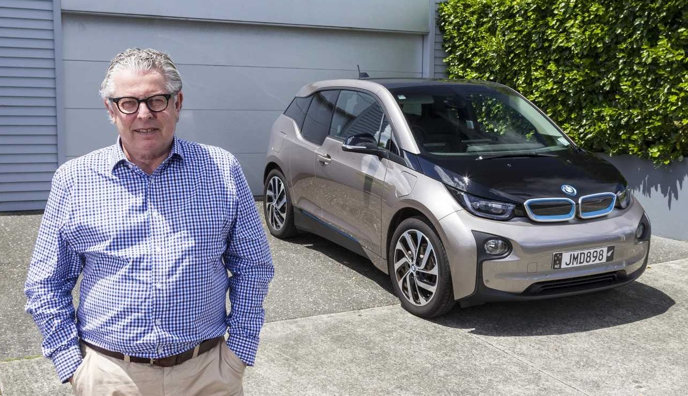
Tax breaks are needed to achieve the Government’s goal of 64,000 electric vehicles on the road by the end of 2021, EV advocacy group Drive Electric says.
The Government should consider adopting Drive Electric’s proposed fringe benefit tax variation ‘Project Switch’, Drive Electric chairman Mark Gilbert says.
“Whilst we stand back and applaud the achievement of 9000 registered EVs on our roads, this rate of growth will not get us to the desired 64,000 EVs,” he says.
Mark Gilbert.
“We need to step up the EV adoption speed and the obvious target is both Government and company fleet purchases – starting ASAP.”
‘Project Switch’ is an incentive that would see EVs purchased by businesses for fleet use attracting the likely lower value of FBT linked to the fleet’s outgoing fossil fuel models.
That’s compared with the higher value that would result if the new EV price was computed without the incentive.
It could be linked to a maximum number of vehicles, or fleet rotations – so the total cost is visible and quantified, Gilbert says.
New EVs cost between $50,000 and $80,000 compared with $30,000 and $40,000 for a comparable internal combustion engine (ICE) car.
The FBT message and opportunity is not new. It is echoed by the Motor Industry Association and the Sustainable Business Council, as well as others, and Drive Electric believes it could be the lever that delivers the best outcome.
“Some big corporates like Drive Electric members Mercury, Meridian Energy and Westpac have taken the financial plunge to transition their fleets to EV technology, despite the upfront cost,” Gilbert says.
“And a recent Drive Electric Whitepaper provided good residual value evidence that should compel others to do the same. “
The Meridian Energy case study used in the Whitepaper showed EVs retained a high residual value of 87% after 14 months, compared with 70-75% for the ICE equivalent.
And the total cost of ownership for one of Meridian’s EVs was $695 per annum compared with $6000-$7000 for an equivalent ICE vehicle.
“It makes more sense for corporates to sell their new EVs at the right time, when their residual value is still quite high than running them into the ground when the vehicles are worth a fraction of their original sale price.”
But many businesses struggle with the idea and aren’t able to make the move to EVs without some help, Gilbert says.
“Businesses that invest in EV technology will reap the benefits of lower running and servicing costs over time.
“And just imagine how many more companies would adopt EVs if there was an FBT incentive, even for a limited period, or coming with other conditions?”
‘Project Switch’, is both an enabler, and an attractive proposition because it would be revenue neutral to companies, and IRD, Gilbert says.

Join the conversation