
Watercare plugs into EVs
 This story first appeared in the August issue of EVtalk – CLICK HERE to download the magazine FREE
Watercare’s entry into the world of EVs is like the cars themselves – quiet but accelerating quickly.
The Auckland Council-controlled organisation (CCO) provides treated water and wastewater services for the people of Auckland.
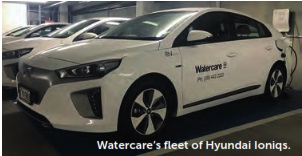
Five white Hyundai Ioniq EVs arrived last year to join the pool fleet at head office in Newmarket, with eight more due to be ordered before the end of this year.
For the first time, the new vehicles will also include two Mitsubishi Outlander plug-in hybrid SUVs.
The EV fleet is used by a range of staff from engineers to planners to the executive team.
Watercare provides services over a huge area— from Wellsford in the north to Tuakau in the south.
The cars have all performed well, apart from the designated executive team vehicle which twice had to be jump-started in the past month.

Watercare head of supply chain Stuart Bird says at first the cause was mystifying.
“The sight of an electric car being jump-started was a little bizarre,” he says.
“Most staff didn’t realise that EVs also have 12-volt batteries that operate air-conditioning, radio, headlights and so forth, in addition to the much larger traction battery which powers the car.
“It took us a while to work out what was going on, then we realised that with this particular car the GPS was draining the 12-volt battery overnight.”
Now the car is running perfectly.
Electric cars are a good fit for Watercare as sustainability lies at the heart of all it does.
“We are committed to energy efficiency and the use of renewable resources,” Watercare says.
For example, both Mangere and Rosedale wastewater treatment plants use biogas from wastewater treatment and that, combined with energy efficiency and innovation programmes, allows Watercare to have a vision of being energy neutral by 2025.
Bird says the arrival of the EVs has created great excitement among staff.
“During our annual Energy Week celebrations in 2017 we brought along a couple of Teslas for people to try, and we were blown away by the reaction.
We had a constant stream of staff wanting to drive them.”
A number of staff own their own EVs and Watercare says it’s clear there’s a growing interest in these vehicles as viable alternatives to petrol cars because they’re cheaper to run and are better for the environment.
Some first-time users at Watercare have been flustered and perplexed by the EVs’ start button system and electric handbrake.
While they are not peculiar to EVs, they can add to initial nervousness.
“We’ve had one or two instances where people have forgotten to charge the EV at the end of the day and then the next morning,” Bird says, the battery has been low, but we have had no instances of drivers being marooned because of flat batteries.”
The overwhelming reaction from staff has been that the EVs are very quiet and comfortable to drive.
Watercare has installed four overnight or slow chargers, and one DC fast charger.
The chargers are only at head office but there are plans to install them at other major Watercare sites such as Ardmore Water Treatment Plant and Mangere Wastewater Treatment Plant.
A free charging unit for public use is located in a car park outside head office.
This was donated by Mercury and is popular with local EV owners.
Watercare hopes to replace the entire Newmarket corporate pool cars with EVs in 2019 and is investigating electric vans for some maintenance staff.

Join the conversation