
Getting back to green – EV camping

This story first appeared in the August issue of EVtalk – CLICK HERE to download the magazine FREE
When two young French women came to EVtalk looking to get their message out to the electric community that they wanted assistance to travel New Zealand using electric vehicles, who would have thought the project would go so far – pun intended.
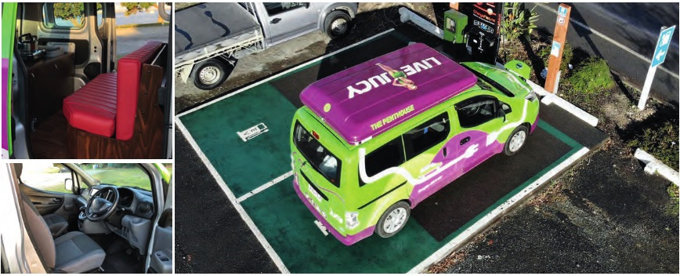
Kiwi tourism icon Jucy already had an electric camper project in the works, and on seeing the story on our website put two and two together – Héloïse de Bokay and Solène Trinquet were given the Nissan E-NV200-based vehicle to do 13,000km around the country.
As they have said many times, that is not easy when your vehicle does only 100km on one charge.
If they can do it, surely so can we.
Jucy handed us the keys to the camper ahead of it appearing on our stand at EVworld, so despite it being the middle of winter we ran with it and headed north.
‘Why north? For one, part of EVtalk is produced out of Magical Mangawhai, and two, the region was quick to adapt to the EV future and has a surprisingly extensive network of infrastructure.
Gaps between chargers heading north of Auckland barely exceed 60km – and stretch as far north as Kaitaia.
Another is planned for Waitiki Landing to make Cape Reinga accessible.
Most of the chargers are part of the Crimson Coast EV Highway and allow you to do both coasts in even a modest range EV – probably the nicest way to describe the Jucy vehicle.
We drove in ECO mode for most of the trip and stuck to 90km/h unless we could get a downhill run.
Even in this mode performance is sufficient out of it the van feels more sprightly than the 80kW and 253Nm power, and torque outputs would suggest.
The steering is soft but needs few turns for tight manoeuvres, while the ride is comfortable and brakes excellent.
The roof-mounted tent does not seem to influence the handling much.
An eNV200 will normally travel around 100 to 120km, but with a substantial interior fit out and ‘Penthouse’ bed on top, 100km is your absolute max – 80-90km is more realistic.
This is compounded by the slowdown of charging over 80%.
Still, we got around with relative ease.
Auckland central to Mangawhai Heads – where we could charge to full overnight, then to Whangarei for a charge on the edge of town and a little shopping, before a relatively easy run to Kawakawa.
Ahh, Kawakawa.
This cute little town with its main street charging station has to be the heart of Northland’s network.
From here we were able to cover much of the Bay of Islands region.
We even popped across to Kaikohe to try the fabulous Ngawha Springs, and while we had planned to top up at the 25kW DC charger in the town, a little cautious peddling saw us back to Kawakawa with time to spare.
Of course the old go-to for EVs on a long journey is a campground.
With 16 amp power, charging is fast and often placed close to tourist locations.
Our campground of choice was the Orongo Bay – Russell Holiday Park.
Tori, James and the team here welcome electric vehicles, regardless of if you are staying.
We came in late, picked a site and plugged in for a charge.
By early in the morning our van was charged, it took less than five hours.
When plugged in the EV camper offers advantages you don’t always get in basic camping vehicles.
You can use heating and cooling system, stereo, and the 12-volt system can be kept charged.
This also runs the fridge and interior LED lighting.
Sit in the back on the comfy red couch and cook yourself a meal.
There is one fossil-fuelled item in the van, the butane cooker.
There is also fresh water and a grey tank under the rear of the vehicle for the hand-pumped sink.
Not that we would recommend relying on it, but a 100 volt, 100 watt AC plug features on this Japanese import van, and we were able to charge a laptop and drone batteries with it.
Handy!
We were hugely impressed by the storage available in the custom-built Jucy setup.
Huge drawers and cupboards under the bench, and a spacious storage area under the seat.
You do not sleep in the van; however, you sleep in the spacious ‘Autohome’ bed that sits on the roof.
It feels like a proper queen size bed with a little extra length to spare.
It is cosy, yet comfortable.
So is New Zealand ready for electric campers like this? Yes and no.
The Jucy van is a well-executed concept, and for some, the range will be enough – you will have to be ready to experience the country at a relaxing rate.
If Jucy were to invest in the new 40kWh eNV200, it would be a game changer.
As you don’t sleep in the van, I wonder if the superior concept could be the fitment of the excellent roof box system and a small kitchen to 30kWh Leafs – these would give 80% of the practicality, with double the range.
Jucy, and this is a commendable move, is ready to move forward, with a plan to have ten vehicles on the road this summer.
“This new fleet of vehicles will need to go much further on a single charge to avoid tourists being stranded,” Jucy founder and chief executive Dan Alpe says.
We couldn’t agree more.
Still, this little vehicle is a definite start.
Watch a video of our experience with the van at our YouTube channel – Auto Media Group.

Join the conversation