
Speed limits likely for micro EVs
 This story first appeared in the August issue of EVtalk – CLICK HERE to download the magazine FREE
Innovation tends to outrun legislation, especially in the micro EV field.
The popularity of such vehicles, like electric bikes and electric scooters, has soared in recent years.
That prompted the NZ Transport Agency to commission Research Report 621: Regulations and Safety for Electric Bicycles and Other Low Powered Vehicles (2017) – authored by Christchurch-based ViaStrada principal transportation planner John Lieswyn.
E-scooters are classed as wheeled recreational devices (if their rated motor power is 300W or less).
Similarly, e-bikes with rated motor power of 300W are classed as pedal cycles.
Up to 25,000 were imported in the past year, nearly double the previous year.
While e-scooters are allowed on footpaths and shared pathways, they’re forbidden on the road – unlike e-bikes.
But pedestrians are increasingly concerned about rising micro EV numbers and speeds on shared paths.
Lieswyn sees e-scooters becoming as popular as e-bikes, particularly in urban areas.
Unlike e-bikes, no helmet is required (New Zealand and Australia are the only two countries with an all-ages mandatory helmet law for bikes).
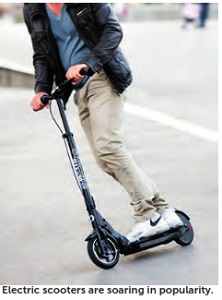
“There is a wide range of scooters – those aimed at children do not go faster than 10-15km/h, smaller adult versions can do 25km/h and some larger models with powerful brakes are capable of over 40km/h.
The faster ones should be allowed on cycleways.”
Radar tests at four Christchurch sites and one in Wellington show e-bike riders tend to have a higher speed than more conventional bikes.
The spot speed test reveals e-bike riders are around 5-7km/h faster than unassisted bike riders, recording about 29.6km/h compared with 24.4km/h for the latter.
Average speed may be governed by variables such as traffic density and intersection spacing, so the speed of an individual rider at a single point along a trip is a useful indicator of potential safety implications, Lieswyn believes.
However, the maximum speed of an e-bike rider is likely to be slower than or comparable to a fit unassisted cyclist.
Overseas, speed limits and other restrictions around LPVs differ.
Self-balancing scooters like Segways and NineBots are legal in the US, but not in most parts of Australia.
Some countries allow throttle use with pedal-assist e-bikes, while others don’t.
Lieswyn says rules may be difficult to enforce, with speed governing at a point of import or sale the most likely solution.
Putting a wattage limit on an LPV may not necessarily work, he says.
“Self-balancing scooters require a lot more power to stabilise a rider and climb hills.
Regarding e-bikes, we’re the only country with a 300Watt law – most are 250W and others, like the US, are 750W or one horsepower.
This leads to some bogus claims in the NZ marketplace, and retailers are asking for regulations that either match Australia or the United States for clarity,” Lieswyn says.
“For e-bikes, it may be better to allow up to 600W – a value that is already stipulated in our legislation as the threshold for definition as a motor vehicle – so you can have enough power to get up hills or assist a cargo bike for carrying children and goods.
For self-balancing scooters, 1500W – as with mobility scooters, and a maximum speed is the way to go.
“So governing the motor cut-out speed is probably the best way.”
Measures based on motor power wouldn’t be easily enforceable, and the power written on the motor may not necessarily equate to the actual power produced, Lieswyn states.
He says our road user rules govern behaviour on pathways, but they are rarely enforced.
“If someone is killed or seriously injured then the rule could be used against someone.
They’re also used for educational purposes.
“But as long as people are behaving responsibly, police aren’t going to stop you from using an e-scooter on a footpath or shared path.
“As more of these things hit the streets and the footpaths, regulatory agencies around the world are already implementing additional rules.”
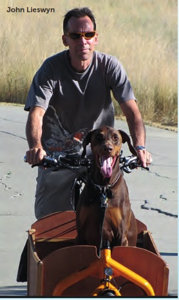
A former US national road cycling champion, Lieswyn’s own e-bike is Canadian and Danish built, which he’s had for five years.
He says he feels safer on it as the speed is sufficient that he’s not always being overtaken by traffic in the Christchurch urban area.
He says the NZTA and the Ministry of Transport are reviewing rules governing LPVs and the use of pathways, with rule changes expected in 2019 or 2020.
Local government will likely have the ability to set local bylaws in relation to specific pathways.
However, these need to be consistent, so central government should hold the “default” position, Lieswyn believes.
He also says shared paths and cycleways should be wide enough to accommodate users safely.
Separating cycleways and paths from other traffic is also happening in New Zealand cities, and encourages more people to use LPVs because they feel safer.
Lieswyn notes that some of their research shows women are taking to e-bikes more than unassisted cycles.
“Women are under-represented among all riders, but less so amongst e-bike riders.”
The research in which Lieswyn and ViaStrada have been involved has assessed the pros and cons of power limits, maximum motor-assisted speed, throttles, age limits, usage locations such as shared paths, licensing and registration.
Now it’s up to the government to decide what’s best for LPVs.

Join the conversation