
Solar power for Hyundai and Kia
Hyundai and its affiliate Kia plan to introduce solar charging technology on selected Hyundai Motor Group vehicles after 2019.
Electricity-generating solar panels will be incorporated into the roof or the hood and will support internal combustion, hybrid and battery electric vehicles with additional electrical power, increasing fuel efficiency and range.
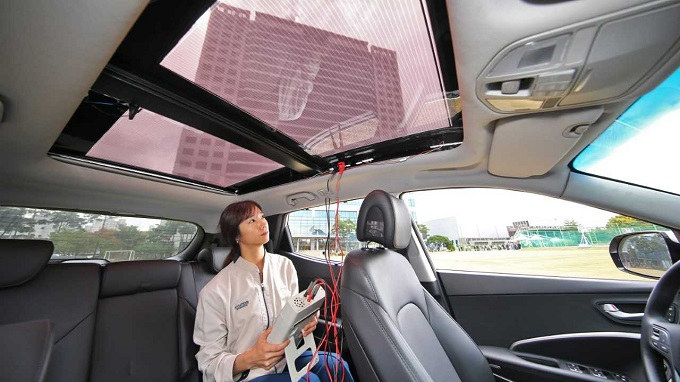
Three types of solar roof charging systems are being developed – a first-generation silicon solar roof system, a second-generation semi-transparent solar roof system, and a third-generation lightweight solar-lid on the vehicle’s body.
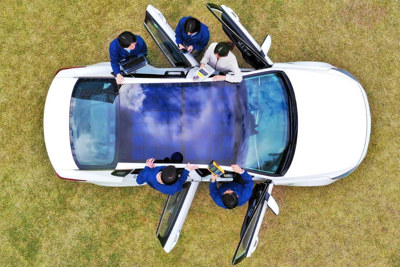 The first-generation system applies to hybrids and includes a structure of mass-produced silicon solar panels mounted on an ordinary roof. This system can charge 30% to 60% of the battery daily, depending on weather and the environment.
The second-generation system goes internal combustion engines (ICE) vehicles – said to be a world first. This system applies semi-transparent solar panels to a panoramic sunroof and Hyundai indicates it can also be used for EVs.
Applying solar charging systems to ICE vehicles will contribute to the increase in vehicle exports, by enabling vehicles to adhere to global-scale environmental laws that regulate CO2 emissions, Hyundai says.
The third-generation lightweight solar-lid system, undergoing a pilot study for applying to eco-friendly vehicle models like EVs, includes a structure that mounts solar panels on a bonnet and roof combined.
The solar charging system is composed of a solar panel, a controller, and a battery. The panel uses photons of light from the sun and creates electron-hole pairs in silicon cells to generate solar electricity.
The electricity is transformed to the standard voltage by the controller, then stored in the battery or utilised to decrease loads of a vehicle’s alternating current (AC) generator.
“In the future, various types of electricity generating technologies, including the solar charging system, will be connected to vehicles,” Hyundai Motor Group engineering design division vice-president Jeong-Gil Park says.
“This will enable them to develop from a passive device that consumes energy to a solution that actively generates energy.”

Join the conversation