
Multilateral co-operation sought on global hydrogen deployment
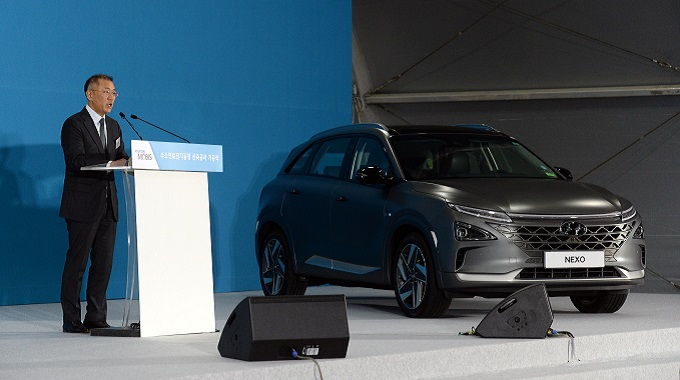
Increased international cooperation to help tackle global climate challenges is sought by Hydrogen Council leaders.
Hyundai Motor Group executive vice chairman and Hydrogen Council incoming co-chair Euisun Chung has made the call, along with current co-chair Benoit Potier of Air Liquide, during the World Economic Forum (WEF) annual meeting in Davos, Switzerland.
The council is a global coalition of more than 50 prominent transport, energy and industrial companies with a shared vision for hydrogen’s integral role in the clean energy transition.
Australia and New Zealand have national hydrogen bodies – Hydrogen Mobility Australia and the New Zealand Hydrogen Association.
Chung and Potier emphasised the need for multilateral cooperation in realising the benefits of global hydrogen deployment, saying public-private collaboration is the only way to move the hydrogen economy from an idea to a real catalyst for the energy transition.
Through collaborative leadership, Chung hopes to contribute to expediting the realisation of a zero-emission hydrogen energy society.
Earlier this year, Hyundai Motor Group reaffirmed its commitment to accelerating the development of a hydrogen society by leveraging the group’s fuel cell technologies, announcing ‘FCEV Vision 2030’. This includes a plan to drastically boost its annual fuel cell systems production capacity to 700,000 units by 2030 and explore new business opportunities to supply them to other transportation, power generation and storage systems sectors.
Aligning to achieving the goals of The Paris Agreement, the Hydrogen Council was launched at the World Economic Forum 2017 in Davos.
Through international cooperation, it works with several key stakeholders such as governments, global agencies, and the private sector, to showcase the benefits of hydrogen technology, seeking to develop a strategic plan to help accelerate major investment into the commercialisation of hydrogen solutions on a global scale.
When produced from renewable and low-carbon sources such as solar and wind energy as well as carbon capture storage (CCS) technologies and solutions, hydrogen has zero carbon dioxide emissions at the point of use.
As noted by a recent McKinsey report, hydrogen could meet 18% of the world’s energy demand.
The Hydrogen Council predicts annual demand for hydrogen will increase tenfold by 2050, creating jobs and bolstering economies.


Join the conversation