
Hydrogen may power British trains
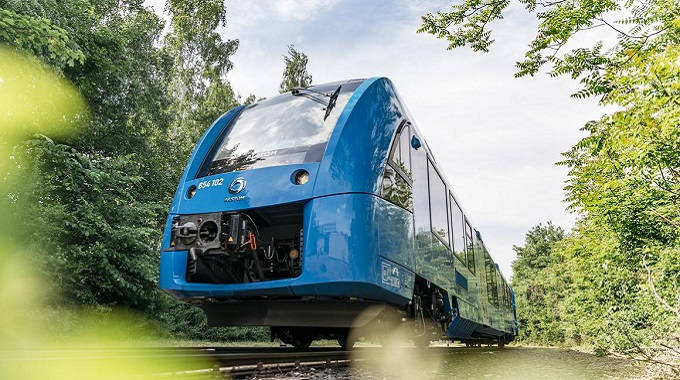
Hydrogen offers hope to get electrification of the United Kingdom’s trains back on track.
While about a third of UK trains are electrified, it became too expensive to continue the switch, resulting in the UK government cancelling plans to electrify lines across Wales, Midlands, and the north of England.
But hydrogen can carry more energy than the same weight of batteries and can be refuelled in minutes, although investment in renewable hydrogen generation and storage are needed first.

Hydrogen trains have already replaced diesel on a line in Germany, and some train companies think such trains could be running in Britain as early as 2022, emeritus professor of finance Brian Scott-Quinn from the University of Reading writes in The Conversation.
He says that without continuing to electrify the network, the government is faced with the dilemma of how to eliminate diesel trains that produce carbon dioxide and other pollutants.
The strategy is to buy trains which switch to diesel when reaching parts of the track without electricity, but Quinn suggests hydrogen could be used instead of diesel at such points.
The hydrogen gas would need to be compressed into tanks stored on the train’s roof, while adding a regenerative braking system to charge an additional small battery would reduce the amount of hydrogen needed to power the train, he says.
If electric trains could switch to hydrogen power for sections of track with bridges or tunnels rather than requiring cables, it could considerably reduce the cost of electrification.
Hydrogen produced from green or renewable sources would be preferred.
Quinn suggests costs will drop as more countries research hydrogen, and that it could even replace natural gas in mains gas pipes, helping bring down the costs of using it for transport.
“The difficulty often seen in trying to introduce a new kind of transport fuel is that vehicle owners won’t use it without the infrastructure to support it, but infrastructure builders won’t install it unless there is demand from vehicle owners.”
A government-funded experiment with hydrogen trains could help overcome that issue and bring the renewable hydrogen economy closer to reality, he says.
Meanwhile, French rail multinational Alstom and UK rolling stock operating company (ROSCO) Eversholt Rail Group have recently unveiled a new hydrogen fuel cell train design for the UK, The Telegraph reports.
Based on the British Rail Class 321, the fuel cell trains – dubbed ‘Breeze’ – will bring zero-emission hydrogen tech to parts of the UK that still run on diesel.
“Hydrogen train technology is an exciting innovation which has the potential to transform our railway, making journeys cleaner and greener by cutting CO2 emissions even further. We are working with industry to establish how hydrogen trains can play an important part in the future, delivering better services on rural and inter-urban routes,” UK rail minister Andrew Jones says.
By converting the electrical multiple units (EMUs) to hydrogen multiple units (HMUs), Alstom will combine the efficiency and practicality of existing rolling stock with the versatility and environmental benefits of hydrogen fuel cells.
Conversion is at Alstom’s Widnes facility could see the first H2 trains running in 2022.


Join the conversation