
Kiwi built EV remembered
This story first appeared in the January issue of EVtalk – CLICK HERE to download the magazine FREE
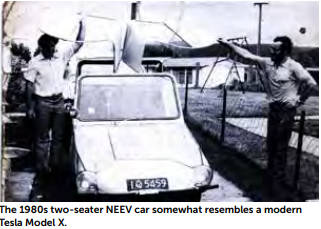
A photo Kay Edgecumbe found recalled his involvement in the production of the first of 10 Natural Energy Electric Vehicles (NEEV) trucks.
He was one of two Christchurch engineers to develop the NEEV in 1980-81, the light truck also able to be used as a utility van.
Posting the photo on the NZ EV Owners Facebook page on January 14, Edgecumbe – now 80 – says it took him and Colin Horsfall five weeks and three days to produce a pre-production prototype EV, which he says could be considered an unofficial world record.
That prototype was a two-seater car with gull wings similar to the Tesla Model X.
“We had to hide it as we knew it was too advanced for the day and went for the truck,” Edgecumbe says.
They designed the truck “from the ground up” and had worked three days non-stop (“with coffee in-between”) to get the truck from Christchurch to Wellington to display on the capital’s wharf.

“At 8.30am we got the batteries from Exide (10 6-volt lead acid 120amp/h), pushed the truck onto a trailer and took it to the wharf and at 9.
30am this pic (with officials) was taken.”
The then energy minister (possibly Merv Wellington) asked to go for a ride, but the electric truck had never been driven and the batteries only installed an hour earlier.
“Well, with a very deep breath and a prayer I said OK,” Edgecumbe recalls.
“He hopped in and I got in the driver’s seat, turned the key and the bloody truck worked first pop – whew!”
The NEEV had a 24-volt pump motor with two rear-wheel drive motors, could reach about 80km/h and had around an 80km range.
 It was capable of carrying two people plus about 400kg cargo.
The charger was locally designed and made.
The Government of the time did not help with the project and the NEEV “died” in 1982.
So New Zealand probably missed a chance to be ahead of the rest of the world in electric truck and van development.
Meanwhile, one of the NEEVs is in Christchurch’s Yaldhurst Museum of Transport and Science, another is in a Nelson collection and a third is in a museum in England.

Join the conversation