
Mercury rising
“New Zealand has enough commercially feasible renewable electricity generation for every car, truck, ferry, train, domestic plane, bike and scooter to be electric. And then some.”
That’s the message from Mercury chief executive Fraser Whineray during the presentation of the energy generator and retailer’s second half of 2018 report which showed healthy earnings nearly match last financial year’s record first half performance, despite less water for hydro generation.
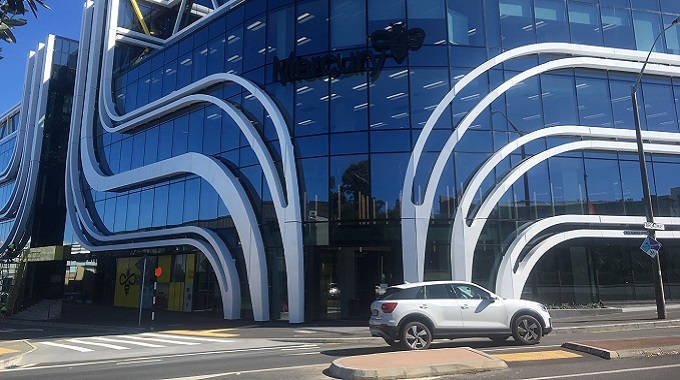
Both Whineray and chair Joan Withers painted a healthy picture of the half year and future prospects at a briefing in Mercury’s new Broadway headquarters in Newmarket, Auckland, on February 26.
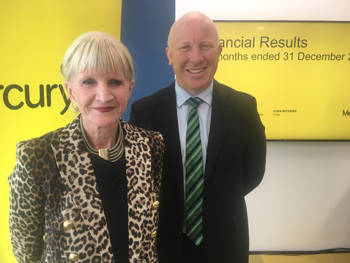
Joan Withers and Fraser Whineray.
Withers says earnings (ebitdaf) of $302 million for the half year ended December 31, 2018, reflected strong execution across the business, underpinned by record spot market prices, a lift in net sales yields, a disciplined focus on costs and planned work.
Mercury will pay an interim dividend of 6.2 cents per share on April 1 to its nearly 85,000 owners, including the Crown. This represents 40% of the full-year ordinary dividend guidance of 15.5 cents per share, an increase of 2.6% on FY2018.
Withers’ 2019 forecast, in her last year as chair, is also healthy with ebitdaf guidance at $515m, assuming 4150gWh of hydro production (150gWh above average, though 50gWh down on initial guidance due to dry weather in the Waikato catchment in the first quarter of this year).
Net profit after tax for the latter half of 2018 of $104m was down from $131m, negatively impacted by the change in fair value of financial instruments (reflecting higher futures prices). Underlying earnings were steady at $114 million.
Capital expenditure of $45m ($59m HY2018) was focused on the advancement of refurbishment work at Whakamaru and Aratiatia hydro stations, IT enhancements and Mercury’s Auckland office consolidation to Newmarket now housing 550 people.
Operating expenditure was $99m.
Whineray says 2019 includes an ongoing programme of investment in core assets, such as the refurbishment of the two hydro stations contributing to the business’s long-term sustainability, while securing the country’s renewable energy advantage. A $75m modernisation project for Karapiro was announced in January.
“We are now five of nine stations into a carefully prioritised programme of upgrades that secures Mercury’s ongoing operations for the long term, while delivering valuable capacity and efficiency improvements,” he says.
Mercury commissioned a grid-scale and grid-connected battery at its Penrose research and development centre, trialling automated trading of battery stored electricity. The trial discharged 285MWh back into the grid in the first quarter of operation.
Whineray says this will be continued and possibly eventually expanded.
He also covered the Government’s Electricity Price Review – which has a final report due later this financial year – and warns the Government to tread carefully on electricity matters to “avoid the tremendous unintended consequences now plaguing Australia, the United Kingdom and Germany”.

Join the conversation