
31 projects approved in low emissions round

This story first appeared in the february issue of Evtalk – CLICK HERE to download the magazine FREE
Megan Woods.
A further 34 public charging spaces, help in switching fleets to electric and a demonstration “garage of the future” are among a record 31 projects getting $11 million in funding.
The boost comes from the Government’s low emission vehicles contestable fund fifth round, administered by the Energy, Efficiency and Conservation Authority (EECA), the recipients announced by energy and resources minister Megan Woods.
“This round of funding focuses on innovative projects that expand the use and possibilities of electric vehicles and other low emissions technology in the transport space,” she says.
“It’s about making new technology available to help Kiwis get around, lower our carbon emissions and contribute to our economy.”
Woods revealed details at Ngai Tahu Tourism in Christchurch, the organisation receiving $139,000 towards seven public ChargeNet NZ fast-charging stations at five key tourist destinations.These are Franz Josef Hot Pools, Dart River Adventures Glenorchy, Earth and Sky Takapo (Tekapo), Shotover Jet Queenstown and Hukafalls Jet Taupo.
A Chargemaster “garage of the future” gets $17,602 towards a demonstration site optimising solar photovoltaic (PV) energy generation, Powerwall home battery storage and EV charging at a rural site prone to power cuts.
A similar project in relation to testing resilience involves Vector’s vehicle-to-home (V2H) trial in Piha, Auckland.
 Vector gets $117,000 towards the project where two smart “vehicle-to-home” chargers and electric vehicle chargers test how the technology can help reduce peak demand and provide short-term power backup.
The chargers will be made available to up to 24 customers for a month each over a year.The project will also gather customer behaviour data.
It is also important to understand the impact larger numbers of EVs have on electricity networks – especially as their popularity continues to rise – and how new customer technologies can help, Vector chief networks officer Andre Botha says.
A key reason for choosing Piha is its single 11-kilovolt feeder cable runs through bush easements, making it vulnerable to cuts.
Vehicle Testing New Zealand (VTNZ) receives $26,000 towards introducing a reliable EV battery condition test and an EV charging infrastructure test.
VTNZ will test batteries reliability and affordability, helping to advance knowledge and skills to develop an EV battery servicing market in New Zealand.
Using the experience of its German parent company, it will develop a test for New Zealand conditions, providing a second-hand EV owner with confidence in battery condition, life expectancy and charging ability and safety.
Ports of Auckland Ltd (POAL) gets $250,000 towards a hydrogen fuel demonstration project.
With partners Auckland Transport, Auckland Council and KiwiRail, POAL will procure hydrogen fuel cell vehicles that will be used and tested as part of the wider hydrogen demonstration project in Auckland.
The funding goes toward one bus and up to three cars.
The project is reliant on the completion of a POAL separately-funded hydrogen plant project, expected to be completed in December 2019.
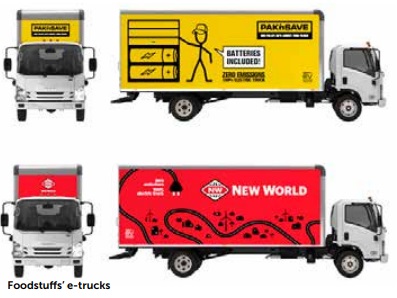
Foodstuffs New Zealand will use nearly $1 million in funding for three new EV projects which include four Isuzu heavy electric trucks delivering products to selected stores in Auckland and Christchurch.
The two six-tonne and two 11-tonne trucks follow the successful trial of 28 full electric delivery vans already deployed – which have clocked up more than 200,000km and saved 37 tonnes of carbon dioxide, company sustainability manager Mike Sammons says.
The electric truck project receives $379,600 from the fund and the trucks arrive mid-2019.
The other two grants of $416,000 and $154,240 go to the installation of seven 50kW and five 25kW public fast chargers at about 12 North Island Pak’nSave and New World stores and four 50kW chargers at South Island supermarkets respectively.
The North Island stores are Napier, Hamilton, Tauriko (Bay of Plenty), Eastridge and Mt Roskill (Auckland), Manukau, Kilbirnie, Churton Park, Karori, Mana, Island Bay, and Silverstream (Wellington).
Bluff, Kaiapoi, Tapanui, and Dunedin are expected to host the South Island ones.
Foodstuffs already hosts 48 fast charge EV stations at its supermarkets throughout New Zealand and will now roll out another 16 fast chargers to total 64.
“The co-funding has supported our partnership with Blackwells Isuzu and SEA Electric for our trucks, and our long-term collaboration with ChargeNet NZ for our store-based chargers,” Sammons says.
“It makes perfect sense for our supermarkets to host fast chargers which customers can use while they shop.”
Meridian Energy gets $62,399 to install public charging stations in partnership with other businesses in Franz Josef Glacier, Aoraki Mount Cook Village, Te Anau, and Christchurch.
Chris Harrington will install a public 50kW fast charger in Otira with the help of $71,075 from the fund to open up the Arthur’s Pass highway and West Coast region, popular with tourists and filling one of the last key gaps in New Zealand’s EV charging network.
A new ORIX NZ EVi initiative receives $135,451 co-funding towards its programme.
This offers businesses with 16 or more lease vehicles on its sole supply agreement the chance to upgrade one fleet vehicle to a selected EV at the same rate as an internal combustion engine (ICE) equivalent.
ORIX will install a charging unit at the business free and provide opening charging credit.
The aim is to remove many of the barriers businesses face when attempting to incorporate an EV into their fleet, ORIX NZ says.
“By removing the additional cost of an electric vehicle, the cost of the charging unit and by handling most of the admin, ORIX helps eliminate these barriers,” the company says.
“This will integrate electric vehicles into a wider range of businesses over a three-year period, giving them the opportunity to experience and fully evaluate an electric vehicle for their organisation.”
Cleaning service provider PPCS will buy an electric rubbish truck, thanks to its $178,550 funding, covering about 4000 Wellington homes, as a step towards replacing 70% of the company’s 60 vehicles with electric by 2025.
The company also receives $208,800 for 10 electric vans to service the cleaning of public toilets within Wellington, Levin, Porirua and Whangarei.An additional three vehicles will be used to service the general cleaning of the community living within the Wellington Council Housing projects.
DHL Express (New Zealand) puts its $62,685 towards buying three LDV EV80 electric vans as part of a courier EV pilot project
One van will operate from each of the main distribution depots – Auckland, Wellington and Christchurch – each having a charger.
DHL aims to collect and deliver 70% of shipments using clean solutions by 2025.
Alsco NZ will run a year’s trial of three SEA Electric E4V commercial vans to prove their suitability for the service industry using its $87,000 funding.
The vans will operate in Auckland, Wellington, and Christchurch.Alsco operates a fleet of 340 vehicles nationwide and will use the trial to determine the replacement of 10 vans per year.
Sanford will lease an electric delivery van and install a refrigeration unit for Auckland central city fresh fish deliveries using its $40,000 from the fund.The company will also install a charger in the Wynyard Quarter, publicly available at limited hours.
Aged care provider Bupa Australia and New Zealand will put its $136,675 towards buying three electric vans to replace diesel ones at its sites in Mangere and Blockhouse Bay in Auckland and Cashmere in Christchurch.A publicly available charger will be installed at each site.
The vans run laundry pick-up and delivery services across four to six sites each.
Another health provider, Ryman Healthcare, will put its $117,500 towards buying an EV fleet and installing a charging station network for retirement living residents, their families, staff and the broader public who regularly visit their five village facilities in Auckland.
With one electric vehicle and two chargers available at each village, Ryman will create a car sharing scheme for the use of residents and staff.
Ebbett Waikato will replace its nine loan-car vehicles with e-Golfs for customers, using its $93,499 from the fund.
Chargers will be placed at its premises.Ebbett expects about 2500 clients annually to experience the e-Golfs.
WELLS Instruments and Electrical Services plans to buy eight EVS with an $80,000 fund contribution for its Auckland energy and utility services field operatives.The company will also purchase and install a Charge Point management solution for four 7kW chargers, two each at its offices in business parks in Penrose and Albany, available to the public.
JA McCallum & Son’s fleet of 14 commercial delivery vehicles covering from Bluff to Queenstown and around New Zealand will gain an electric van to test the viability of EVs for its business.
The company receives $35,000 towards the project.
If successful, McCallums intends electrifying its entire fleet within the next five years.
Contact Energy and OptiFleet have partnered to help their commercial and industrial customers reduce fleet emissions, getting $484,300 in help.
They will establish a fund to undertake comprehensive GPS-driven fleet utilisation reviews, providing data for clients to streamline their fleets and convert to low emission vehicles.The project will support large scale charging infrastructure installation.
Real Journeys has $167,254 to help start transitioning its fleet through procurement of two Hyundai Konas and the installation of EV charging stations at Te Anau, Queenstown and Manapouri.
Pit Stop will purchase a fleet of electric courtesy vehicles for clients and set up dedicated EV service bays at four Christchurch workshops using its $1215,150.
It will also establish a mobile EV flat battery service.
YMCA Invercargill will procure two second-hand EVs and one charger for its corporate fleet using $18,000 from the fund.
The EVs will help deliver programmes for about 500 young people annually.
Visit www.eeca.govt.nz/funding-and-support/low-emission-vehicles-contestable-fund/ for more information.

Join the conversation