
I-Pace leads JLR’s electrification
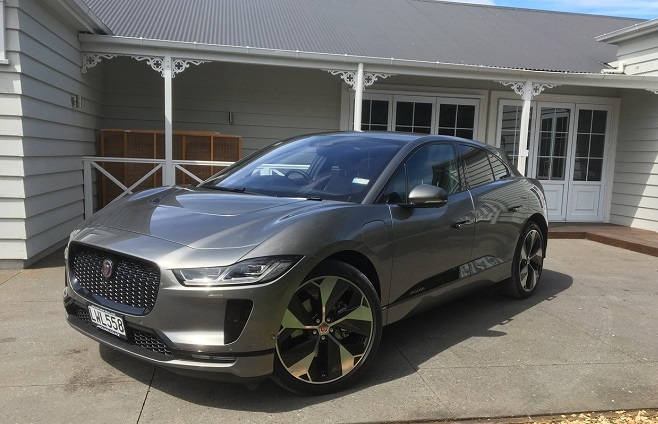
The Jaguar I-Pace electric SUV and new plug-in hybrid versions of the Range Rover line-up now on sale in New Zealand lead an electrification strategy for every model in the range featuring some kind of electric motor by 2020.
Over the next year, Jaguar Land Rover (JLR) will release a torrent of models equipped with larger batteries, including mild hybrid versions of the Range Rover Evoque, and further plug-in hybrid (PHEV) models following in the wheel tracks of the new $174,900 Range Rover Sport and $223,900 Range Rover Vogue SE.
The prices of these two new P400e PHEV models represent an increase of between $4000-$5000 over equivalent petrol-only models. The premium buys a 13kWh rear-mounted battery that stores enough energy to drive the Rangies up to 51km on the power of the 85kW electric motor alone.
Mounted up front is a 225kW 2.0-litre petrol engine, and when using both combustion and electric energy in tandem, the newest Range Rover powertrain can produce 640Nm. The battery can be recharged in 7.5 hours using a house socket, or 2.5 hours on an AC charger.
Official fuel consumption numbers start with a two in terms of litres of petrol used every 100km, and the dual-engine vehicles can sprint to 100kmh in six seconds. Towing capacity is reduced when compared with petrol-only versions, down from 3500kg to 2500kg.
The new I-Pace represents an even greater step towards electrification as it relies on magnetic power alone. It arrives here fresh from winning the European Car of the Year award, where judges praised its handsome design and sporty driving dynamics.
Although weighing 2133kg, the I-Pace has the lowest centre of gravity of any Jaguar thanks to the skateboard-like mounting of the 90kWh battery. The 36 battery modules are evenly distributed over the vehicle’s entire floor, resulting in perfect 50/50 weight distribution. Jaguar finished off this highly-dynamic chassis with steering and suspension systems taking full advantage of the potential for agile and stable handling.
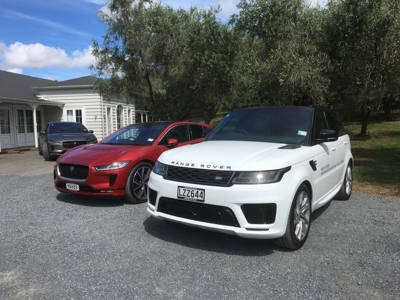 Under the Worldwide harmonised Light Vehicle Testing Procedure (WLTP) testing, the I-Pace has consumed 21.2kWh of power every 100km, resulting in a range of 470km.
A 7kW AC home charger will recharge the battery in 12.9 hours, while a 100kW public DC fast charger will replenish the spent battery with enough energy to travel a further 100km in 15 minutes.
With an electric motor mounted in each wheel, the I-Pace produces 696Nm of driving force in a highly tractable fashion. With no gearbox or other driveline to produce transmission loses, it can sprint from 0-100km/h in 4.8 seconds and up to a maximum speed of 200km/h. Aerodynamic efficiency is enhanced through the vehicle automatically lowering above 105km/h, the active grille shutters, and the flush door handles.
Prices start at $159,900 for the S model, rising in two 10-grand steps to the $179,900 HSE flagship.
Speakers at the New Zealand launch of the electric Jaguar and battery-enhanced Range Rovers included I-Pace production racer Simon Evans and Sustainable Coastlines founder Sam Judd.
Judd best summed up the three new additions to the New Zealand JLR range.
“These new vehicles offer plenty of ‘go’ (I-Pace) and plenty of ‘tow’ (Range Rover P400e PHEV), and more New Zealanders will feel attracted to them.”

Join the conversation