
High spec, long wait for Leaf
This story first appeared in the March issue of Evtalk – CLICK HERE to download the magazine FREE
 As a Kiwi at an international electric vehicle event these days, you can feel a little smug.
While many may still disparage the efforts of our government and market to grow the number of electric vehicles, when you are sitting amongst journalists from Australia and other markets what appears a minimal attempt to us looks light years ahead to others.
As was the case last week when EVtalk headed to Hong Kong for the Nissan Futures event, a series of discussions with Nissan leadership and industry experts on the future of mobility – electrification, autonomous vehicle technology and how the way we travel will transform cities.
It was also the chance to drive the Leaf that will – finally – arrive in New Zealand later this year.
There is a wait, with Australia confirmed as getting the car in August, and ours likely to come around the same time.
What are we getting? EVtalk can confirm New Zealand Leafs will be sourced from the United Kingdom and feature a relatively high specification.
 There will be one specification initially, and at least initially only the 40kWh model.
The specification will include active cruise control, a 360-degree camera system, auto high-beam lights, front and rear parking sensors, and an eight-inch touchscreen with navigation, Apple CarPlay and Android Auto.
Creature comforts include leather upholstery, heated seats, a heated steering wheel and climate control air-conditioning.
Safety features include autonomous emergency braking, lane keep assist, a frontal collision warning and rear cross traffic alert.
The much talked about e-pedal system comes as standard but the Pro Pilot driver assistance system is not yet on the menu.
While we have tried it in New Zealand and it works, Nissan still wants to validate it in local conditions.
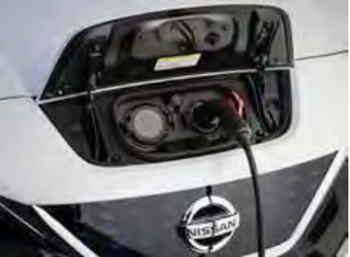
 The Chademo port remains under the front flap of the Leaf, with Nissan quoting a 20-80% DC charge time of around an hour.
The 7kW hour onboard charger means a charge in as little as 6-7 hours on a level two charger, 24 hours on the provided lead.
Like other UK Leafs of this age, there is a type 2 rather than type 1 port.
And the price is? Well, we can not tell you yet.
Australians can now preorder the car for $49,990, or $51,600 in New Zealand currency.
EVtalk’s speculation is not to expect the Leaf at that price point, with it likely to fall between $55,000 and $60,000.
That would be inline or undercut similarly specified Uk imported models, and of course, have the support and warranty that comes along with being a new vehicle.
It would also match or undercut the Hyundai Ioniq with its 28kWh battery.
This time around, sales and service will be opened up to a broader group of dealers – a sign Nissan is a little more confident it can chase volume with the car.
Yes, EVtalk has already driven the car, but the chance to do it on an official basis with some idea of what we are getting brings a new element to the experience.
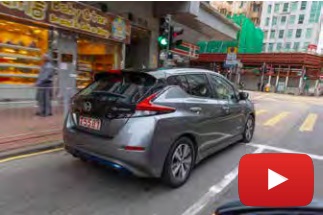
We headed out of our Kowloon hotel with a local minder onboard and headed through the congested tunnel to Hong Kong Island to experience the car.
The new Leaf gets a useful power boost over the old one, up to 110kW and 320Nm – again more than an Ioniq.
You can vary the car’s balance of responsiveness to efficiency using an ECO mode button, or increase regeneration using a B mode in the transmission.
The car feels nippy, hit the pedal too hard and you can get some front tyre scrabble, particularly on damp roads.
Once you have adjusted to the experience, it makes for a smooth driving experience.
Bye, bye gearshifts.
The new Leaf carries over the ball-style gearshift of the current model.It works, why change it.
The e-pedal system comes with a little bit of a learning curve, though ultimately feels surprisingly natural.
Once activated, lifting off the pedal gives you four times more engine braking than you get in a petrol-powered vehicle.
It takes out a lot of the guesswork about the best places to put power on or regenerate, helpful on the up-and-down roads that run across the hills about Hong Kong.
Australasian Leafs will retain the firmer European suspension tune rather than the more comfort-orientated setup of Japanese cars.
There is nothing to fear here – it is not uncomfortably firm and will likely make the car feel a little more engaging on our open roads, even if it did feel delete firm on Hong Kong’s somewhat uneven tarmac.
With the battery sitting low the Leaf feels very stable and solid.
The steering has a nice weight to it and is quicker and responsive.
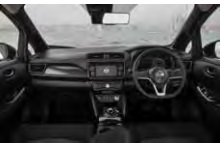
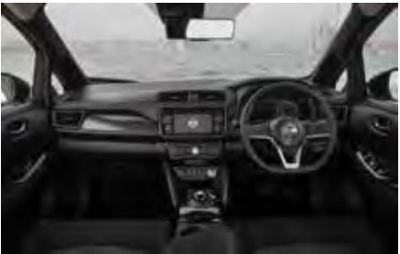
While some higher quality plastics would be nice, the interior of the Leaf is a comfortable place to be.
The digital dash screen is relatively simple and feeds information to the driver in a low distraction way.
The 8-inch touchscreen is easy to use and importantly is responsive, while the climate control buttons are carried over from the old model.
The front seats with their stitched leather are comfortable, though with no steering reach adjustments finding the right driving position will be a mission for some drivers.
The rear seat is of a good size for a small hatch, though oddly a central drive shaft hump remains for the centre passenger, and the angled windows give it a closed-in feel.
The boot is sizeable, likely helped by the lack of a spare tyre.
If there is an annoyance here, it is the Bose subwoofer which runs across the leading edge of the trunk – somewhat reminding me of the inconvenience of the charger hump in type one cars.
There is much more to discuss around the arrival of the Leaf, though some of that will have to wait until we get official pricing and cars on New Zealand shores.
Until then you can check out more from the event in this magazine, including discussions with Nissan Australia and New Zealand managing director and chief executive Stephen Lester, Nissan’s global electric vehicle director Nicholas Thomas and more from Hong Kong.

Join the conversation