
Global total renewable energy possible in 30 years
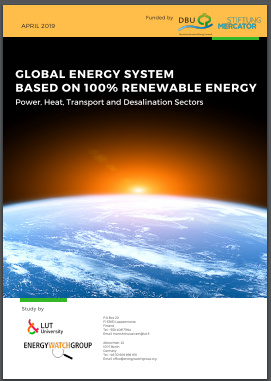 A global transition to 100% renewable energy by 2050 in transport, power, heat and desalination is feasible.
That’s according to a four-and-a-half-year study by the Energy Watch Group and LUT University in Finland, involving 14 scientists as well, into how the world can meet the 1.5°C target of the Paris climate treaty.
The fastest and cheapest way is to switch everything to electric (including vehicles), using mainly solar and wind sources which are expected to comprise 96% of renewable electricity generation by 2050, the study notes.
Greenhouse gas emissions in the energy system could be reduced to zero even before 2050, it says.
“The report confirms that a transition to 100% renewables is possible across all sectors, and is no longer more expensive than the current energy system,” Energy Watch Group (EWG) president Hans-Josef Fell says.
“It shows that the whole world can make the transition to a zero-emission energy system. That is why all political powers around the world can and should do much more to protect our climate than they currently envision.”
EWG and LUT can now also develop national roadmaps for the transition to 100% renewables, tailored precisely for the individual countries’ respective context, Fell says.
“The study’s results show that all countries can and should accelerate the current Paris Climate Agreement targets,” LUT University solar economy professor Dr Christian Breyer says. “A transition to 100% clean, renewable energies is highly realistic – even today, with the technologies currently available.”
Franziska Wessel from Fridays For Future also called on policy-makers to take immediate action: “This study shows what is possible if our politicians are willing to act. We – Fridays For Future – call for a completion of the transition to 100% renewables by 2035.”
A key finding includes global primary energy generation will consist of solar energy (69%), wind power (18%), hydropower (3%), bioenergy (6%) and geothermal energy (2%).
A 100%-renewable electricity system will employ 35 million people worldwide. About nine million jobs in the worldwide coal mining sector from 2015 will be phased out completely by 2050, with more than 15 million new jobs created in the renewable energy sector.
By 2050, the world’s population is forecast to grow from 7.2 billion in 2015 to 9.7 billion. Final energy demand is expected to grow by about 1.8% annually, driven by energy services for higher living standards and accompanied by massive energy efficiency gains.
Final energy fuel consumption is reduced by more than 68% from 2015 numbers, as fossil fuels are phased out completely and remaining fuels are either electricity-based or biofuels. Electricity will constitute more than 90% of the primary energy demand in 2050.
The study concludes with political recommendations for a rapid integration of renewable energy and zero greenhouse gas emission technologies.
Measures suggested include promoting sector coupling, private investments, tax breaks and legal privileges with simultaneous discontinuation of subsidies for coal and fossil fuels.


Join the conversation