
Hyundai introduces electric double-decker bus
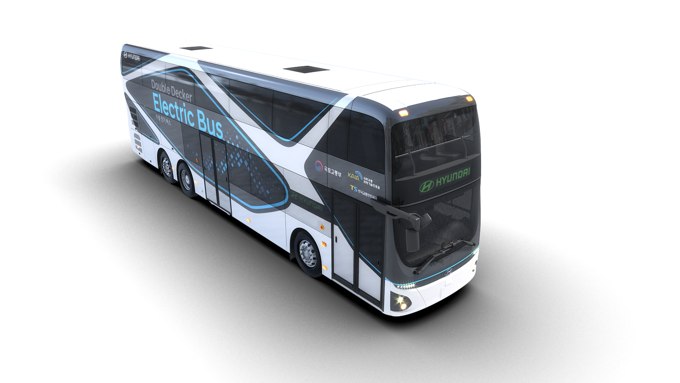
Hyundai has unveiled its first electric double-decker bus.
The 70-passenger e-bus with an estimated 300km range is part of the company’s effort to help reduce traffic congestion and air pollution.
It is on display at the Land, Infrastructure and Transport Technology Fair in Korea, May 29-31.
Hyundai worked for 18 months on a project for the bus, supported by the Korean Ministry of Land, Infrastructure, and Transport, which began in 2017.
The bus has 11 seats on the first floor and 59 seats on the second floor – 1.5 times as many passengers compared to a regular bus. Access for mobility impaired passengers is provided through two fixed-in-space wheelchairs, an automatic sliding ramp and a low floor design.
It has a 384kWh water-cooled high-efficiency polymer battery and can be fully charged in 72 minutes.
The bus is nearly 13-metres long and about four metres high. It runs on an independent suspension system in the first driving axle for a more comfortable ride, and a 240kW wheel motor axle combined with a motor in the second axle that minimises electricity loss. A rear-wheel steering system works in conjunction with the steering system for the first axle, optimising steering performance.
“The double-decker electric bus is an environmentally friendly vehicle optimised for global eco-friendly trends,” Hyundai commercial vehicle advanced engineering team head ByoungWoo Hwang says. “This will not only ultimately improve the air quality, but also contribute greatly to easing commuting hour traffic congestion by accommodating more passengers.”
Advanced safety features include vehicle dynamic control (VDC) which helps identify the driver’s intended driving direction and maintains control, forward collision-avoidance assist (FCA) and lane keeping assist (LKA).

Join the conversation