
Electric flight to take off
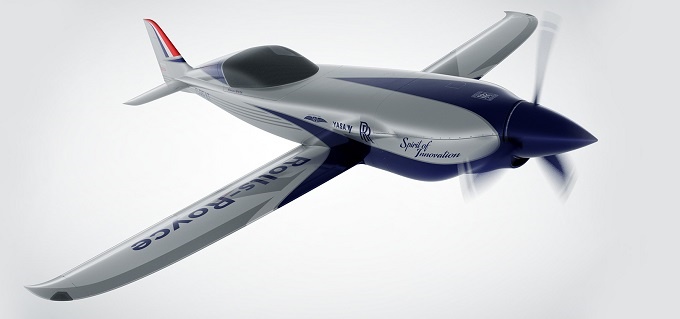
An electric aircraft from Rolls-Royce is set to destroy a world speed record.
Its ACCEL (Accelerating the Electrification of Flight) aircraft aims to exceed 480km/h in a flight in England in 2020.
That would beat the electric flight record of nearly 338km/h set by Siemens in 2017.
Rolls-Royce is building the high-performance electric aeroplane in a hangar at Gloucestershire airport in South West England.
It’s no stunt – the ACCEL is intended to pioneer a third wave of aviation in support of Rolls-Royce’s strategy to champion electrification, the company says.
ACCEL is partly funded by the British government and involves a host of partners including electric motor and controller manufacturer YASA, aviation start-up Electroflight and Formula E racing people.
“This plane will be powered by a state-of-the-art electrical system and the most powerful battery ever built for flight,” ACCEL project manager Matheu Parr says.
“In the year ahead, we’re going to demonstrate its abilities in demanding test environments before going for gold in 2020 from a landing strip on the Welsh coastline.”
Rolls-Royce was instrumental in helping Britain win the prestigious Schneider Trophy in 1931, a victory that established Rolls-Royce as a leader in aerospace.
ACCEL has the most energy-dense battery pack ever assembled for an aircraft, providing enough power to fly 322km on a single charge.
Its 6000 cells are packaged for maximum lightness and thermal protection. An advanced cooling system can withstand the extreme temperatures and high-current demands during flight.
Coincidentally, IDTechEx chairman Dr Peter Harrop has released the latest edition of a report Manned Electric Aircraft 2020-2030.
He says there’s interest in making eight to 100-seat pure-electric aircraft or, more realistically, hybrid interim versions first, such as the Faradair BEHA.
“NASA did a concept video of something disturbingly like a coffin lifting you out of your garden called Puffin.
“About 100 organisations have raised money or concepts in that quirky vertical take-off and landing (VTOL) arena, mainly offering pure-electric zero-emission.”
However, batteries do not yet exist to lift such aircraft for city flight with safe endurance margins, he believes.
“Some say they will dispense with the pilot to get range when the law permits.”
Uber finds the primary VTOL impediments to be certification, cost and safety but it has deep pockets and it is in for the long haul.
A few companies have quietly progressed towards a modern version of the tens of thousands of little single-propeller fixed-wing aircraft.
BlackBird, a US on-demand flight service – think Uber for planes – will purchase 100 four-seat Bye eFlyer4 pure-electric planes and 10 eFlyer 2 and Norway’s OSM Aviation has ordered 60 for pilot training. Boeing says the world needs more than 500,000 pilots trained over the next 20 years.
“Such near-silent aircraft should be allowed to fly almost at any time, like a taxi operating 24/7 on land,” IDTechEx chief executive officer Raghu Das says.
“Since an increasing majority of people live in apartments in cities with no garden and increasingly with no parking space, flying cars and VTOL air taxis will be more niche than these fixed-wing aircraft.”
Visit www.IDTechEx.com/Manned for more information.

Join the conversation