
Watercare accelerates EV fleet
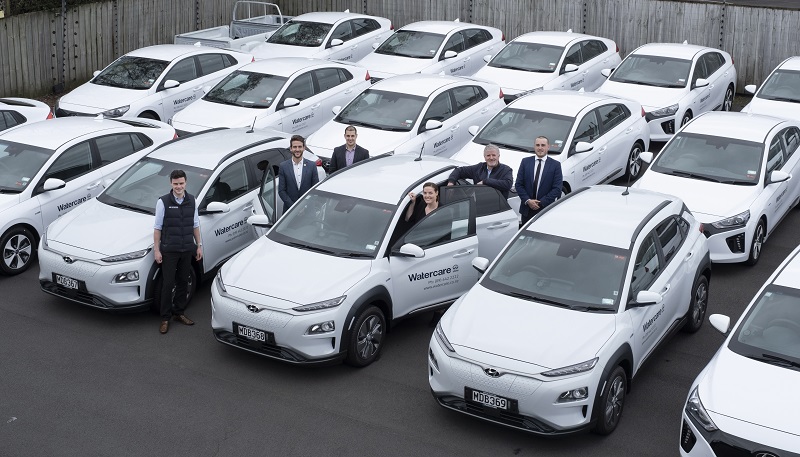
Watercare’s electric vehicle fleet has gone from five to 30 in under a year.
Three new Hyundai Kona and 20 Hyundai Ioniqs arrived in September, with another two Ioniqs going to Auckland’s central interceptor team in October, relating to the $1.2 billion 13km Western Springs to Mangere wastewater pipeline project.
That means more than 33% of Watercare’s entire passenger fleet is now electric with the old petrol vehicles – some 10 years old – to be sold.
The new EVs bring many benefits, Watercare fleet manager Samantha Schofield says.
“Typically, the old vehicles would use around 40,000 litres of fuel, costing us around $95,000 per year.
“EVs cost the equivalent of around 30 cents/litre to fully charge their battery (on slow charge), so we’ll be making significant savings on fuel costs and more importantly, from now we’ll be removing 45 tonnes of carbon dioxide from the environment―and that’s so exciting!”
Schofield says Watercare is committed to energy efficiency and the EVs are helping it achieve sustainability goals.
New fleet EV charging points have been installed at Newmarket, Pukekohe and Mangere wastewater treatment plants.
Rosedale’s plant will receive five double chargers in October, with plans to gradually roll out chargers at other sites, including Ardmore and Warkworth water treatment plants.
A different approach is being taken for heavy-duty vehicles, such as trucks, vans and utes.
Schofield says the cost of electric trucks is disproportionate compared to diesel models. “There is a limited range of EV trucks around and now they can cost three quarters of a million dollars, as opposed to $250,000 for a standard diesel truck.
“As a result, we’re investigating the opportunity of sourcing hydrogen from wastewater or re-purposing methane gas and converting it into hydrogen, which we can use to power our heavy vehicle fleet in future.”
Hydrogen fuel-cell vehicles are far quicker to fill up, around six minutes instead of 12 hours on slow charge.
They also have good range (about 650km) and have the same instant torque and quiet performance, Schofield says.
The Government has recently outlined its plans for how hydrogen fuel could be used in New Zealand.
About $250,000 will go to First Gas, which owns all the North Island’s natural gas pipelines, to figure out how to use its pipes to pump hydrogen.
Schofield is reminding Watercare staff to plan their route with its new EVs.
“We recently had a staff member who took five hours to get back from Ngaruawahia because they couldn’t find a fast charge point and a top-up in Huntly using a slow charger took forever. By the time she got to our Pukekohe plant the vehicle had just 1% charge left.”
For short distances, staff are encouraged to consider alternative, more sustainable travel options such as public transport.


Join the conversation