
Energy companies Surge ahead
Electricity companies like Mercury, Meridian Energy, Genesis and Contact are reporting a profitable financial year, a generally rosy outlook and more investment in electric vehicles and renewable energy.
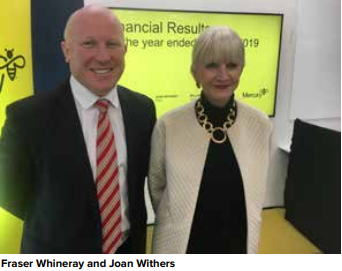
Mercury chair Joan Withers steps down on September 27 on a high note, the company again announcing a record net profit after tax of $357 million – up 53%.
Tribute was paid to her guidance and input over 10 years by chief executive Fraser Whineray at Mercury’s financial year results briefing which included references to electric transport and renewable energy.
Withers has championed those two factors.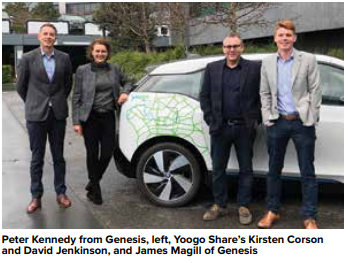
“Joan has been hugely committed as chair of the company,” Whineray says, describing her track record as “tremendous”.
Withers is looking to replace her long-running Mitsubishi Outlander PHEV with a new EV but hasn’t decided what sort.
And EVs will continue to play a major role in Mercury’s future.
Whineray says solid long-term demand growth is anticipated as renewable electricity’s advantages are unlocked through technology advances in areas such as transport.
“We will continue to explore inspiring ways to encourage the transition to electrified transport for the long-term benefit of the country as well as our owners,” he says in reference to Mercury’s highly successful electric ‘Evie’ 1957 Ford Fairlane promotions.
Whineray talks about the “awesome foursome” of renewables – sun, water, steam and wind – the latter involving Mercury’s first wind farm underway at Turitea near Palmerston North.
“The great thing about renewables is that they do not require another party – just nature,” he says.
Mercury is ready for an expected boost to EV uptake in New Zealand and has itself converted every vehicle it can to EVs with more than 84 of Mercury’s 115 fleet now electric, including PHEVs.
Meridian Energy reports record earnings and net profit off the back of its strong hydro conditions, trans-Tasman customer growth and higher wholesale market prices.
Renowned for supporting EVs, Meridian says its net profit reached $339 million, up from $201m.
The company has been supportive of the government’s Electricity Pricing Review.
“We support action and policies that result in a genuinely fairer, more affordable, competitive and efficient energy market,” chief executive Neal Barclay says.
Meridian has also continued to lead the industry’s response to climate change, strongly backing the Zero Carbon Bill while announcing plans to reforest 1000 hectares and halve its operational emissions by 2030.
The company is among finalists in the 2019 NZI Sustainable Business Network Awards.
“Enhanced by our new identity that underscores Meridian’s commitment to 100% renewable generation from wind, water and sun, we’re working with government, industry, communities and individuals to make the bold changes needed to achieve a net zero carbon New Zealand,” Barclay says.
Earlier this year, Meridian joined the international EV100 initiative, pledging to operate a 100% electric fleet by 2030.
It also has an Electric Car Plan providing cheaper rates and other benefits for residential EV owners.
Genesis Energy has also stepped up on EVs, the electricity retailer investing $2 million for a 40% stake in Yoogo Share, an EV car-sharing company helping businesses and individuals reduce their carbon emissions.
With 200 tonnes of CO2 already saved by Yoogo Share, Genesis is excited about what the new partnership will achieve.
Yoogo Share’s experience in EV fleet management and charging infrastructure, combined with Genesis’ customer and brand reach, will go a long way to achieving momentum in this essential and growing sector, retail markets executive general manager James Magill says.
“There is a groundswell of activity from individuals, business and government to support NZ’s emissions reduction targets, and we hope to support that.Partnering with Yoogo Share enables a solution to help our customers further reduce their energy costs and carbon emissions.”
In announcing the deal, as part of its annual results, Genesis chief executive officer Marc England says this will provide significant opportunity for Genesis’ business customers, many of whom are on the verge of transitioning pool car fleets to EVs.
Yoogo Share chief executive officer David Jenkinson says the traditional fleet industry is changing.
“Research suggests that by 2024 car-sharing will have grown to 40,000 cars in New Zealand and Australia.With a solid base in Christchurch and expansion into Auckland and Wellington under way, we’re delighted to have Genesis’ support which enables us to meet the increasing market interest in our service.”
Genesis has committed to transitioning 100% of its light vehicle fleet to EVs by 2020 and 50% of trucks by 2025.About 41% of the light vehicle fleet has already been converted and four hybrid trucks have begun service.
Genesis says its prior year’s $20 million net profit has increased to $59m, with underlying earnings increasing 16% to $67m.
Reliable electricity is central to New Zealand’s decarbonisation and this year Genesis’ flexible generation assets have ensured energy security for all New Zealanders during a period of unplanned and significant natural gas supply constraints and low hydro inflows, England says.
“Through our Future-gen programme we are committed to supporting New Zealand’s transition to a lower carbon future; offsetting our emissions through local forestry, improving efficiencies across our generation business and partnering to build a new wind farm in South Taranaki.”
Commenting on the Yoogo Share investment, England says the Yoogo model, supported by Genesis, will reduce average running cost per kilometre, avoid unneeded capital expenditure, lower carbon emissions and enable more flexible transportation for New Zealand businesses and their employees.
Contact has also boosted profit to $345 million, up 161% from $132m.
It’s moving toward developing a renewable power station at Tauhara with a commitment to drill four appraisal wells there.
“New Zealand is undergoing a transformation from reliance on fossil fuels to renewable electricity,” Contact chief executive Dennis Barnes says.
“Contact is well placed to meet the expected growth in electricity demand which will result in meaningful reductions in the nation’s carbon emissions by developing our large scale consented geothermal development options backed by our world-class geothermal capability and strong balance sheet.”



Join the conversation