
Tribunal decision carries warning for EV dealers

This story first appeared in the August issue of EvTalk – CLICK HERE to download the magazine FREE
Traders who sell Nissan Leafs – or for that matter any electric vehicle where the battery condition can be assessed – have been given a strong warning in a recent Motor Vehicle Disputes Tribunal decision.
The case, Khoo vs Autolink Cars, related to a purchaser’s claim that he had been mislead by the trader telling him the Nissan Leaf he was considering had a battery “State of Health” of 78%.
Within 10 months of ownership this has fallen by 9%.
SOH is a number generated by the car’s battery management system and accessed through aftermarket software.
The car displays battery health using a less-volatile 12-bar gauge.
Leaf spy is commonly used to access the data from Nissan EVs, though alternative software exists for other vehicles.
In support of this submission, the trader – Autolink director Henry Schmidt – referred the tribunal to an article published on the flipthefleet.
Org website, dated November 1, 2018, which it says confirms that battery SOH can decrease significantly after importation from Japan.
The tribunal’s assessor agreed – noting the explanation provided by the trader is entirely plausible, and that the vehicle’s battery SOH can reduce substantially when a vehicle is imported into New Zealand from Japan because of factors such as the time taken to import the vehicle into New Zealand, changes in weather conditions and temperature and changes in the vehicle owner’s driving and charging habits.
The tribunal found for Autolink in that the car had no fault under the Consumer Guarantees Act, although found against him under the Fair Trading Act by failing to clearly advise the customer the number could change.
“Given the importance of this information, I consider that a reasonable consumer would expect that, where a motor vehicle trader makes a representation as to the vehicle’s SOH before it is imported to New Zealand, the trader would then tell it that the battery SOH could reduce by as much as 8% when the vehicle was imported into New Zealand.”
The adjudicator noted this decision could have ramifications for dealers.
“I appreciate that this finding is likely to have significant ramifications for traders who sell electric vehicles imported from Japan and who use the vehicle’s pre-import SOH reading in their marketing. And so it should.If traders want to use this type of potentially unreliable information in their marketing, they must make it clear to prospective purchasers that there is a real risk that the battery SOH could be significantly lower once the vehicle is imported into New Zealand. Failure to do so will expose those traders to potential liability under the FTA.”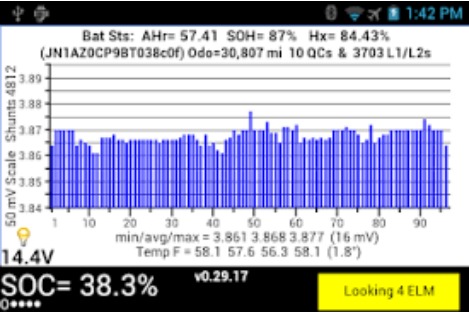
Speaking to AutoTalk, Schmidt noted he was given a clear warning by the adjudicator that traders need to be careful about advising customers of “State of Health.”
Schmidt, an early mover in the electric vehicle market, says the dealership stopped advertising SOH figures following the case – but has since reversed that decision to providing them.
“It is because 99% of the customers ask for it – we much prefer talking about bars,” he says.
“If we do not promote the percentage, they think we are hiding something.
Schmidt says they do their best to educate customers on what the SOH is.
“We tell them it goes up and down, you might have a different reading in winter and summer. You might fast charge the car a few times and it goes up.”
Dave Boot of Christchurch’s EV City notes that while SOH is an important figure for comparison, it should be only part of the discussion when selling an electric vehicles.
“If you sell based on that rather than a figure, which is a BMS best guess based on input and output data then you are setting your customers up for misery,” Boot says.
“Buy one in the Japanese summer and sell it in winter, there is going to be a difference in the state of health,” he notes.
That is not to insinuate the Japanese are misrepresenting cars, it is just the way the systems work.”
Boot says the sales process for an EV should be around what the customer expects to do with the vehicle, what they actually need – not whether it will mathematically do it based on the statistics Leafspy provides.
“We have refused to sell cars to people who don’t have realistic expectations.”
He notes an issue for the industry is dealers that lack experience or have not done their research on the vehicles providing misinformation.
“I know dealers who have told customers the SOH will only drop 2% a year, and that is absolute rubbish.”
“We had a dealer turn up here last month to get the battery tested for the customer, he turned up, lifted the bonnet and disconnected the battery.
He took the positive and negative terminals off the 12-volt battery and told us he had the car ready for us.
“Some dealers should stay away from electric vehicles. Not because we are greedy, but because a bad EV experience by a customer is likely to be off-putting to their friends and family.”
Boot is not suggesting Schmidt is in this camp, however.
“I think that is more a case of the dealer and the customer not getting along and not having a proper conversation about what SOH means.”

Join the conversation