
Mercury backs EVs and sustainability

This story first appeared in the november issue of evtalk CLICK HERE to download the magazine FREE
Mercury’s brand colour is yellow but its new headquarters at 33 Broadway in Newmarket, Auckland has a high five-star Green Star rating.
That means it’s of sustainable design, construction and operation.
The 33 Broadway developers, Mansons TCLM is one of the top developers to achieve Green Star ratings.
 Green Star buildings usually bring high-calibre tenants like Mercury, which consolidated about 600 staff at Broadway, and the other key tenants Tegel and Avanti Finance.
For Mercury, 33 Broadway provides plenty of open space in the top three levels of the five-storey building, multi-use rooms and associated facilities, an auditorium-style open space central atrium with a big screen, display areas, basement parking (including EVs and e-bikes) with chargers, and a curved 1950s retro façade.
A cafe called Newbie has since opened in the building, helping attract more custom as it’s close to public transport and major retail areas.
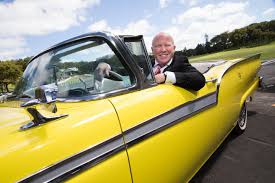
A variety of interactive displays in Mercury’s foyer keep the public entertained, such as a “make your own hydro-electric power station” in a kinetic sand pit with special lights, and a mock-up of Mercury’s electric “Evie” 1957 Ford Fairlane complete with virtual reality headset.
Evie and VR headsets displaying a drive in the car proved popular at Big Boys Toys’ Electric Avenue as visitors swarmed to Mercury’s stand on November 1-3 at the ASB Showgrounds in Auckland’s Greenlane.
Keynote speaker for the November 1 Electrifying Conversations Conference at the same venue, Philippe Vangeel of the European Association for Electromobility was impressed with Mercury’s display and tried the VR drive.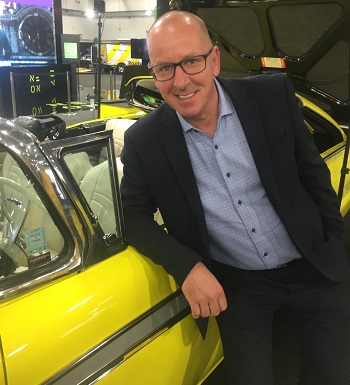
Vangeel says his surname is associated with yellow – a key colour on the family crest.
Meanwhile, some other big changes are happening at Mercury with Joan Withers stepping down this year as chair, succeeded by Prue Flacks, and chief executive Fraser Whineray leaving early next year after 11 years of service at Mercury to become chief operating officer at Fonterra.
Whineray has championed EVs throughout his tenure.
The company helped introduce the 30% committers pledge in 2016 where some 30 New Zealand companies promised to do their best to switch at least 30% of their vehicle fleets to electric by the end of 2019.
Mercury has been collecting insights during the three-year pledge period and expects to check on progress again shortly, possibly for the last time.
When the pledge was made about 2000 EVs were registered in New Zealand, so it was designed to encourage doubling fleet EVs and to normalise EVs as a viable alternative to internal combustion engine (ICE) vehicles.
Momentum since has been strong, with registrations now past 17,562.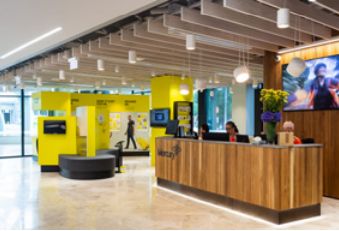
Most companies have exceeded numbers aimed for, Whineray says.
Some others have struggled for various valid reasons which provided insights useful to others, he adds.
“We expect all companies will get beyond the numbers pledged at some point .
“Pleasingly, many more organisations beyond the initial pledgees have lifted their game. Influencing the market has therefore been a good outcome.”
It’s unlikely an extension to the pledge deadline will be sought.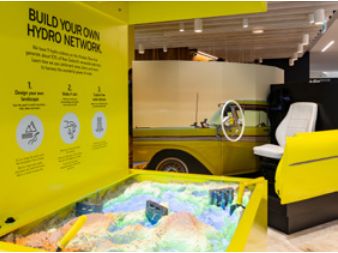
The intention was to support and show leadership that contributes to momentum.
That momentum is now evident – when three years ago it wasn’t, Whineray says.
He says electrification is now going well beyond EVs, “beyond what we could have almost imagined then”.
Whineray points out that e-bike sales and e-scooter use have rocketed, Ports of Auckland will have the world’s first electric tug, Zephyr Airworks is trialling electric and pilot-less air taxis in Twizel, Waste Management is converting 800 trucks to electric, electric campervans are hitting the road, and three EV car sharing models are offered, along with Mercury’s car subscription service Mercury Drive.
Unfortunately, the public sector is lagging in uptake compared to the private sector, Whineray believes.
“We look forward to a lift in public sector uptake over the next year or so, along with growth of some of the initiatives noted, being further catalysts for momentum that collectively enable New Zealand to make a real change that makes the most of our largely home-grown renewable electricity.”

Join the conversation