
Electric Island Waiheke – one year on
This story first appeared in the december issue of evtalk CLICK HERE to download the magazine FREE
Cyril Wright had probably one of the first EVs on Waiheke Island, which has the goal of becoming all-electric by 2030.
And his Polaris off-road EV is a little different from the mainly Nissan Leaf EVs permeating the island off Auckland.
He’s using it on a subdivision to cart tools, fuel and materials across the site mainly to service fossil – fuelled machinery, and recently had the Polaris’ eight lead acid batteries replaced with three new lithium ones to gain more range and performance.
“It goes well and runs most of the day now before needing recharging,” Wright says, adding he can plug it in at home.
Previously, he was lucky to get a couple of hours from a single charge.
Wright’s interested in getting an electric motorcycle as well.
Polaris Commercial agent Max Lyness, an EV specialist with SG Equipment, helped Wright with his upgrade and provides Polaris Ranger EVs to clients and works with transitioning diesel forklifts to Yale electric forklifts.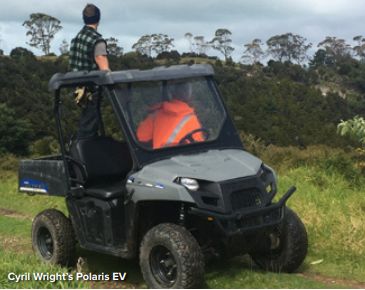
He once worked with Yamaha selling electric golf carts in New Zealand and he has been investigating Polaris GEM two to six-seater shuttles and carriers.
Lyness hopes to introduce French Goupil G4 compact electric utility vehicles to the island and elsewhere in New Zealand.
He is working with agencies over regulations allowing such EVs, the Goupil G4 having a modular chassis concept providing for customisation such as roll-up door vans, refrigerated vans, rubbish/recycling collection, a fixed or tilt deck and more.
The EV can carry up to 1226kg, suits stop and go applications and can house several battery capacities with a range of up to 130km depending on customer requirements.
Meanwhile, the Waiheke Golf Club has introduced an electric mower, adding to the island’s growing EV list, with the Clean Green Lawnmowing Company also setting up on the island.
The island had 42 EVs when Christina Bu of the Norwegian Electric Vehicle Association launched the Electric Island Waiheke project.
In just one year, the number of EVs has trebled to more than 120, possibly nearer 160 with many Waiheke EVs domiciled on the island but registered elsewhere.
Since July, Electric Island Waiheke has had more than 125 Waiheke residents, families and companies try an EV thanks to Auckland dealership GVI Electric, which has loaned Waiheke four EVs.
Multiple EVs have been sold as a result, with many other Waiheke residents planning to switch when their cars come up for replacement.
Dozens of residents now get around the island on electric bikes and e-scooters too.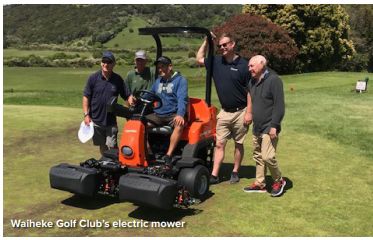
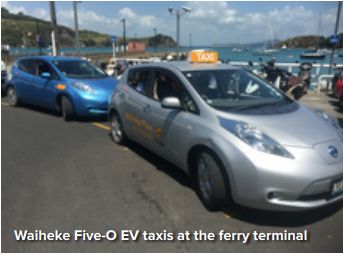
Progress on other fronts include three of the island’s taxi companies running EVs, Waiheke’s new bus fleet switching to EVs, the Waiheke Health Trust aiming to replace its four vehicles with EVs starting with the first one pre-Christmas, and Fullers committing to a significant fleet of fast electric ferries.
The company is working with Michael Eaglen who has set up EV Maritime in partnership with McMullen & Wing with the goal of replacing all Waiheke ferries with an all-electric fleet.
Electric Island Waiheke plans two major events in 2020 – a two-day public EV showpiece (March 14-15), which will feature an attempt on the world record for the number of Nissan Leafs in one place at the one time (on an island) – coupled with an “open home” introduction to the resilience of living with 100% solar power.
On March 16-17 there’s a two-day national and international conference on “EVs and beyond” organised by EVtalk magazine at the Waiheke Island Resort.
With Vector and Energy Efficiency and Conservation Authority support, Electric Island Waiheke is assisting in the deployment of 80 “smart” home EV chargers and eight public fast chargers – the first public chargers on the island – plus a mobile charger for the AA roadside assistance service.
Finally, a charitable trust has been formed under the patronage of Sir Rob Fenwick to drive the efforts of the founding group so that momentum is maintained and stepped up in 2020 and beyond.
Footnote: Electric Island Waiheke needs to increase the number of EVs on the island by 50% annually to replace all vehicles with electric models by 2030.
This target should be helped by a range of new EVs at lower prices becoming available on the New Zealand market from 2022, including utes and heavy trucks.

Join the conversation