
EV battery developed from seawater

Hot on the heels of an Australian lithium-sulphur battery project featured in EVtalk comes news that IBM has developed an EV battery using three materials extracted from seawater.
IBM says it’s probably the first time the materials – which include lithium from seawater – have been combined in a battery, avoiding mining of heavy metals for such purposes.
The ‘seawater’ battery outperforms conventional lithium-ion batteries, IBM says, researchers claiming it takes five minutes to get an 80% charge and has potential to improve EVs and energy storage.
“Overall, this battery has shown the capacity to outperform existing lithium-ion batteries not only in the previously listed applications, but can also be optimised for a range of specific benefits,” says Dr Young-Hye Na, who leads the researchers in materials and process innovations for the energy industry at the IBM Almaden Research Centre in San Jose, California.
She says in her blog
these include lower cost (free of heavy metals like cobalt and nickel), faster charging, high power density (exceeding 10,000 W/L), high energy density (more than 800Wh/L), excellent energy efficiency (over 90%), and low flammability of electrolytes.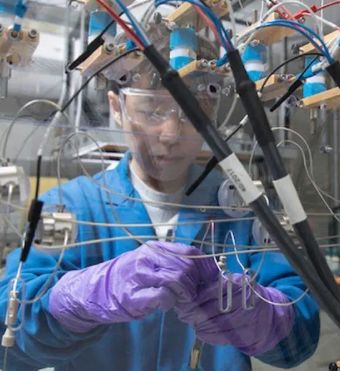
Na says IBM Research has joined with Mercedes-Benz Research and Development North America, a leading battery electrolyte supplier Central Glass, and battery maker Sidus to move to commercial development.
”This discovery holds significant potential for electric vehicle batteries, for example, where concerns such as flammability, cost and charging time come into play,” she says.
“In the quickly evolving arena of flying vehicles and electric aircrafts, having access to batteries with very high-power density, which can scale a power load quickly, is critical.”
Na says the research team has also implemented an artificial intelligence (AI) technique called ‘semantic enrichment’ to further improve battery performance by identifying safer and higher performance materials.

Join the conversation