
Toyota plans hydrogen city
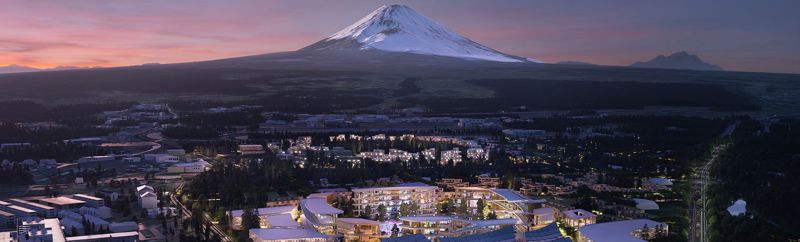
Toyota plans to build a prototype “city” of the future on a 71-hectare site at the base of Mt Fuji in Japan.
Called the Woven City, it will be a fully connected ecosystem powered by hydrogen fuel cells, the company says in announcing the city at the Consumer Electronics Show (CES) 2020 in Las Vegas.
Fully autonomous, zero-emission vehicles only will be allowed on the main thoroughfares.
Envisioned as a “living laboratory,” the Woven City will serve as a home to full-time residents and researchers who will be able to test and develop technologies such as autonomy, robotics, personal mobility, smart homes and artificial intelligence in a real-world environment.
“Building a complete city from the ground up, even on a small scale like this, is a unique opportunity to develop future technologies, including a digital operating system for the city’s infrastructure,” Toyota Motor Corporation president Akio Toyoda says.
“With people, buildings and vehicles all connected and communicating with each other through data and sensors, we will be able to test connected AI technology… in both the virtual and the physical realms… maximizing its potential.”
Toyota will invite other commercial and academic partners and interested scientists and researchers globally to work on their own projects in the new city.
“We welcome all those inspired to improve the way we live in the future, to take advantage of this unique research ecosystem and join us in our quest to create an ever-better way of life and mobility for all,” Toyoda says.
Danish architect Bjarke Ingels of Bjarke Ingels Group (BIG), which designed the World Trade Centre in New York, Denmark’s Lego House and Google’s Mountain View and London headquarters, will draw up the city.
“A swarm of different technologies are beginning to radically change how we inhabit and navigate our cities,” Ingels says.
“Connected, autonomous, emission-free and shared mobility solutions are bound to unleash a world of opportunities for new forms of urban life.”
The city’s masterplan includes streets for faster vehicles only, for a mix of lower speed, personal mobility and pedestrians, and for a park-like promenade for pedestrians only.
The city is planned to be fully sustainable, with buildings made mostly of wood to minimise the carbon footprint, using traditional Japanese wood joinery, combined with robotic production methods.
Rooftops will be covered in photo-voltaic panels to generate solar power in addition to power generated by hydrogen fuel cells.
Homes will have latest in human support technologies, such as in-home robotics to assist with daily living. The homes will use sensor-based AI to check occupants’ health, take care of basic needs and enhance daily life, creating an opportunity to deploy connected technology with integrity and trust, securely and positively.
Autonomous Toyota e-Palettes will be used for transportation and deliveries ,as well as for changeable mobile retail.
Toyota plans to populate Woven City with Toyota Motor Corporation employees and their families, retired couples, retailers, visiting scientists, and industry partners. The plan is for 2000 people to start, adding more as the project evolves.
Ground breaking starts on the site in early 2021.
Visit woven-city.global for more information.
A Toyota city already exists in the Aichi Prefecture, Japan, with about 426,162 residents in a 918.32 square kilometre area. It is about 35 minutes from Nagoya by way of the Meitetsu Toyota Line and several of Toyota Motor Corporation’s manufacturing plants, including the Tsutsumi plant, are there.
Longstanding ties between the Toyota Motor Corporation and the town of Toyota-shi, formerly known as Koromo, gave the town its current name.

Join the conversation