
Robot shuttles a major new transport form
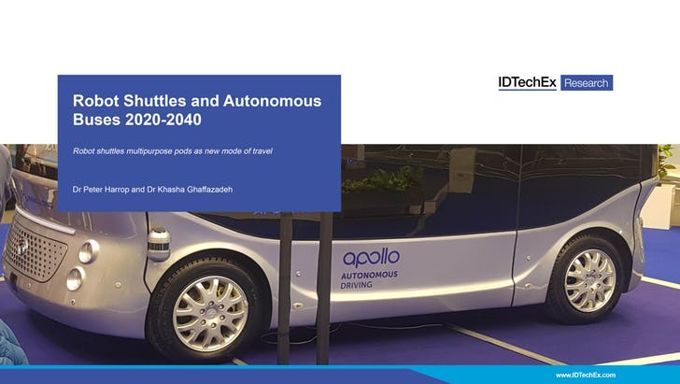
Robot shuttles are an important new, reconfigurable form of transportation for goods and people that may even function as mobile offices, workshops, restaurants and more.
So says IDTechEx in its first in-depth report on this called Robot Shuttles and Autonomous Buses 2020-2040.
Boxy eight to 20-person symmetrical vehicles like a small train that never do a u-turn are likely to be the norm, it says.
“Small footprint, all-round vision, large doors, quiet, zero emission, they can go indoors and over piazzas and roads and are able perform many different tasks even in one day,” IDTechEx chairman Dr Peter Harrop says.
“Primarily intended for intensive urban use, they are gated to never exceed a determined speed, typically in the range 50-60km/h.”
It adds up to a new form of transport backed by huge companies like Toyota and Baidu and start-ups, one having raised US$1 billion for the task, Harrop says.

Trials explore many possible applications, from empowering the poor and disabled, to viably filling in gaps in the transportation network and replacing underutilised vehicles such as private cars, reducing congestion and cost, he adds.
Out of 36 different robot shuttle models and precursors examined in 15 countries and deployed in 20, IDTechEx identifies nine with excellent design, successful trials, strong backing and imaginative multi-purposing and taking the mainstream 14 or so passengers when in bus mode.
A few have more than 100 units deployed, and nearly all usually have tele-supervision and a supervisor on board.
However, the technology for fully independent Level 5 robot shuttles will not be widely deployable until later in the decade, the report predicts.
IDTechEx finds robot shuttles cater for city growth and feeder services, plus travel demand for all – including those that cannot afford or manage existing forms and those located where demand does not justify a regular bus.
“Road congestion must be eliminated by banning those little used and weakly filled vehicles such as private cars from cities and introducing vehicles intensively used because they reconfigure in use, even go indoors, move sideways and arrive at your door,” Harrop says.
In Switzerland, the robot Postbus even manages narrow bridges and narrow roads with both post and passengers.
IDTechEx predicts robot shuttles will never plug in. Smart windows selling advertising and making electricity, vehicle-to-grid income and other income streams are likely.
Last mile freight is another, all raising the prospect of people travelling on the back of it.
An Amazon delivery and school bus robot shuttle has even been conceived.
At the 2020 Tokyo Paralympics Toyota will transport the disabled more efficiently, safely and pleasurably using its new robot shuttles, while it is also exploring modes such as freighter, mobile shop and office.
A large amount of electricity and money is needed both for the robotics and the vehicles, IDTechEx says.
“That will be overcome with a tsunami of new technologies. Software and telecom companies are often leading but it is a long game, delayed by inadequate autonomy.”
The report also explains huge advances in vehicle technology from solar, supercapacitor, colour changing and self-healing bodywork to smart glass, 360-degree wheels and more, helping provide a profusion of income streams and business cases, long life and near zero maintenance.

Join the conversation