
Keeping cool as EV market heats up
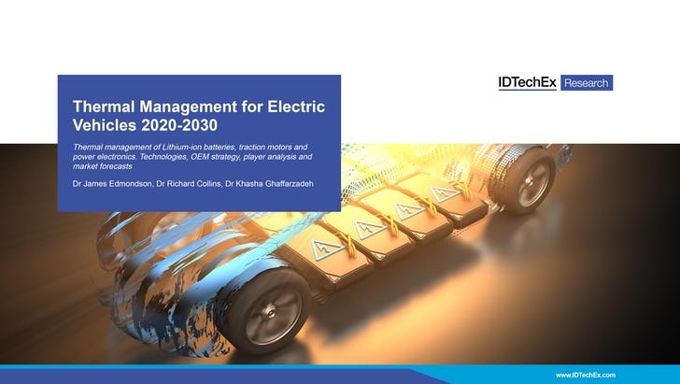
As the EV market grows and for it to reach its full potential there is an increased need for effective thermal management of the vehicles.
Keeping heat under control leads to improved charging, performance, range, longevity and safety.
A new report from IDTechEx covers several aspects of thermal management for electric vehicles including the batteries, motors and power electronics.
Thermal Management for Electric Vehicles 2020-2030
is a new report from technology analyst Dr James Edmondson, principal analyst Dr Richard Collins and research director Dr Khasha Ghaffarzadeh.
HThere have been several high-profile battery related fires from well-known automotive manufacturers and in stationary energy storage from South Korea does little to instil confidence in potential consumers, they say.
New regulations proposed relate to safety aspects unique to EVs, the likely outcome of this being that manufacturers will be required to halt thermal runaway at the individual cell level and warn the vehicles occupants, giving them at least five minutes to exit the vehicle once a thermal event occurs.
Several factors must be considered when designing an EV for safety, from the materials used in the battery pack construction to thermal runaway prevention and early detection, the report suggests.
Some companies are designing methods of stopping thermal runaway between cells including flame retardant encapsulants, interweaved products and phase change materials. Effectively dissipating heat from the battery module or pack to a heat sink is also important and usually carried out using a thermal interface material, another area where manufacturers have adopted strategies including gap pads, fillers and conductive adhesives.
Every manufacturer has its own methodology to thermally manage batteries with no clear consensus on the most effective design, the report notes.
Companies like Tesla are set on their patented water-glycol coolant lines which “snake” their way between the cylindrical cells in the pack, whereas OEMs like Nissan and Toyota are committed to air cooling.
Active cooling of batteries with fluids allows the vehicle to be kept cool in conditions where the vehicle is stationary but the batteries are in high demand (eg, during fast charging), but also allows the batteries to be raised to optimal temperature in cold conditions. These are significant advantages but come at the expense of weight, complexity and cost. Despite these caveats, IDTechEx has observed a market shift towards liquid or refrigerant cooling and foresee this trend continuing. That’s especially following the rise of charging with 350kW sources, with the amount of liquid or refrigerant cooled batteries exceeding 500GWh by 2030.
Cooling strategies for plug-in electric vehicles will be developed during the next 10 years, with a shift towards liquid and refrigerant cooling, the report suggests.
Other emerging alternatives such as immersion cooling and phase change materials are gaining modest traction, especially for more specialised markets like construction. This report appraises all these methods of cooling in addition to the players using them.
More demand is being put on electric motors for high performance during extended use.
While the motor may not pose such a safety risk as the batteries, most manufacturers use motors containing permanent magnets. These magnets can be denatured and rendered useless above a critical temperature and therefore also need effective thermal management, the report adds.
Even motors without these permanent magnets are still required to be kept cool to improve performance and reduce the risk of overheating neighbouring components.
The methodologies adopted typically consist of air, oil or water-glycol cooling, several manufacturers using the same coolant circuit for their batteries and motors, reducing components and fluids while simultaneously allowing for excess motor heat to warm the batteries or passenger cabin in cold conditions.
Power electronics also have to deal with significant heat, especially with the trend towards operating at higher power densities and temperatures.
The way in which wire bonds and soldering is done as well as the material used makes a big impact on the performance and longevity of the power electronics, the report notes.
“Several OEMs are also shifting towards using advanced substrates and even eliminating the thermal interface material altogether.”
Visit www.IDTechEx.com/research/EV or contact research@IDTechEx.com
for more information.

Join the conversation