
Solar farms can reuse EV batteries

Solar energy farms could offer a second life for EV batteries, according to a new study by the Massachusetts Institute of Technology (MIT).
It shows battery reuse systems could be profitable for both EV companies and grid-scale solar operations.
As EVs increase in popularity globally, a “wave” of used batteries no longer suitable for EVs to meet range and acceleration needs will become available for possible useful and profitable backup storage for grid-scale solar photovoltaic installations, where they could perform for more than a decade in this less demanding role, MIT News reports.
The study, published in the journal Applied Energy
, was done by six current and former MIT researchers, including postdoctoral fellow Ian Mathews and mechanical engineering professor Tonio Buonassisi – Photovoltaics Research Laboratory head.
As a test case, the researchers examined a hypothetical grid-scale solar farm in California.
They found that a new battery installation would not provide a reasonable net return on investment, but that a properly managed system of used EV batteries could be a good, profitable investment as long as the batteries cost less than 60% of their original price.
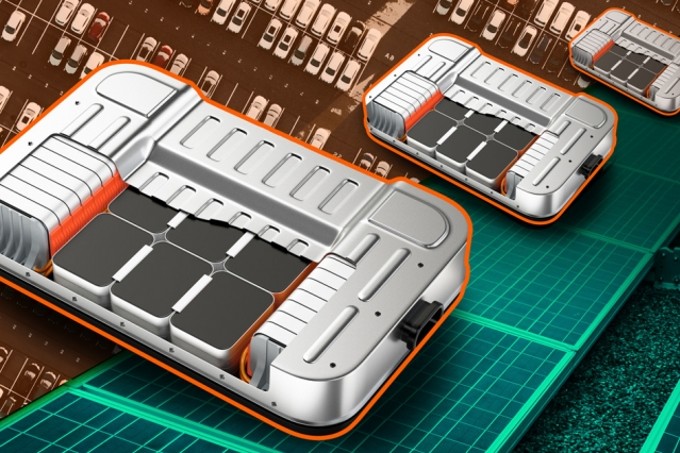
“How do you screen batteries when you take them out of the car to make sure they’re good enough to reuse?” Mathews asks.
“How do you pack together batteries from different cars in a way that you know that they’ll work well together, and you won’t have one battery that’s much poorer than the others and will drag the performance of the system down?”
The study does prove the economic side, showing there’s enough value left in the batteries to justify the cost of taking them from cars, collecting and checking them and repackaging the batteries into a new application.
Researchers found the batteries could achieve maximum lifetimes and value by operating under relatively gentle charging and discharging cycles — never going above 65% of full charge or below 15%, dispelling assumptions running the batteries at maximum capacity initially would provide the most value.
Longer-term studies are needed to determine if the batteries can operate at 60% capacity or lower for a lengthy period, with many EV makers already starting on such pilot studies, Mathews says.
In part, degradation is determined by the way the batteries are controlled. “So, you might actually adapt your control algorithms over the lifetime of the project, to just really push that out as far as possible,” Mathews says.
“We think this could be a great application for machine-learning methods, trying to figure out the kind of intelligent methods and predictive analytics that adjust those control policies over the life of the project.”
A recent report from McKinsey Corp shows that as demand for backup storage for renewable energy projects grows between now and 2030, second-use EV batteries could potentially meet half of that demand, Mathews says.
Some EV companies, including Rivian – founded by an MIT alumnus, are already designing their battery packs specifically to make this end-of-life repurposing as easy as possible, he adds.
Mathews says that “the point that I made in the paper was that technically, economically, … this could work.”
For the next step he says, “There’s a lot of stakeholders who would need to be involved in this: You need to have your EV manufacturer, your lithium ion battery manufacturer, your solar project developer, the power electronics guys.”
Mathews adds the intent is to say, “Hey, you guys should actually sit down and really look at this, because we think it could really work.”

Join the conversation