
EV demand accelerating
Sales of high voltage hybrids (HEVs), plug-in hybrids (PHEVs), and battery electric vehicles (BEVs) all saw an increase in most regions across the globe in spite of COVID-19.
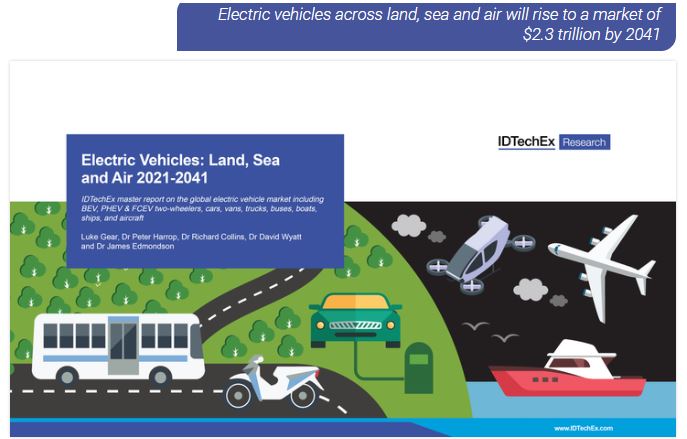
So says IDTechEx in its report Electric Vehicles: Land, Sea and Air 2021-2041 which shows very strong growth for those vehicles in Europe especially.
“Clearly, there is a growing and accelerating demand for EVs.”
BEVs continue to gain market share and big automakers that have been slow or reluctant to adopt BEVs are finally making big investments and transitions towards electrification, IDTechEx says.
“There are still challenges to widespread BEV adoption, whether this be range anxiety, charging infrastructure, or cost, these concerns are starting to fade and with the roadmaps set out by so many automakers and governments, IDTechEx expects BEVs to be the dominant form of transport in the long run.
“COVID-19 has had a drastic effect on the automotive industry. We have seen shutdowns of factories, fewer people commuting to work, and an overall shift in the landscape of transport,” IDTechEx says.
“Car sales in 2020 dropped by 6% in China, 24% in Europe, and 14% in the US.”
In spite of the overall impact on the automotive industry, sales of electrics have risen in most regions across the world.
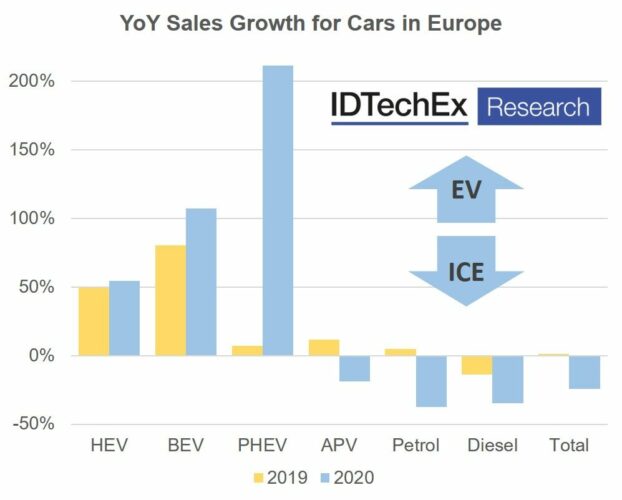
“If we take Europe as an example, sales of petrol, diesel and other alternatively powered vehicles (APVs) all saw a significant decline in 2020, but HEVs were up 54%, BEVs up 107%, and astonishingly, PHEVs were up 211%,” IDTechEx explains.
HEVs are currently the drivetrain of choice for Japanese automakers such as Toyota and Nissan, with very strong sales for these companies across Japan and Europe, the report suggests.
“They are a much more mature technology than BEVs and PHEVs, but still provide improved economy and CO2 figures which help meet emissions standards and can be sold in much larger quantities currently.”
In spite of only a moderate fuel consumption and emissions reduction, IDTechEx sees a very promising market for the HEV in the next decade, especially in the EU, before post-2030 fossil fuel bans start to hamper their market.
The massive growth of PHEVs in Europe has been driven by Germany and automakers BMW, Audi and Mercedes.
PHEVs are often purchased as company cars thanks to their low fuel consumption and CO2 emission ratings.
They also help automakers to meet their emissions targets but are somewhat controversial in this regard because the real-world values can differ significantly from the ratings on the WLTP cycle.
IDTechEx believes that PHEVs will not continue to be looked upon so favourably when it comes to emissions and under revision of current driving cycles will become far less beneficial for automakers and their emissions targets.
Join the conversation