
A 10%-80% charge in under five minutes, says Nyobolt

Nyobolt’s ultra-fast charging batteries have moved from the lab to the track.
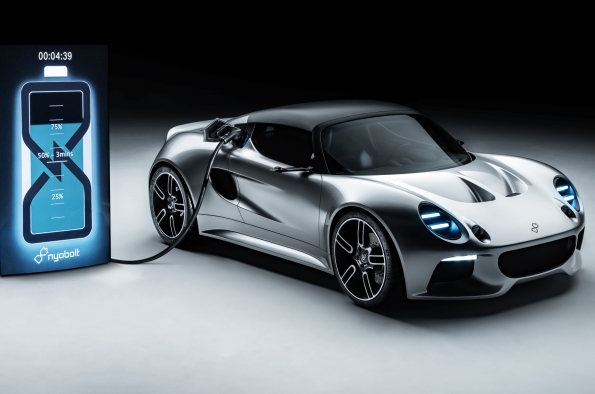
year after revealing the concept, a driveable Nyobolt EV prototype, engineered together with Callum, will do advance testing of the ultra-fast EV charging technology in the real world, enabling OEMs to experience Nyobolt’s claims,
Initial testing of the Nyobolt EV using a 350kW DC charger has shown its batteries can charge from 10% to 80%in under five minutes, without the degradation typically associated with lithium-ion batteries, the United Kingdom-based company says.
Independent testing of Nyobolt’s technology by a leading global OEM confirms that Nyobolt’s longer lasting and more sustainable batteries can achieve more than 4000 fast charge cycles, or 965,606km (600,000 miles), maintaining more than 80% battery capacity retention, it says.
Nyobolt says it is in talks with eight OEMs about using its technology in high performance EVs.
The Nyobolt EV will be used to both validate the company’s battery performance in a high-performance environment, as well as allow car makers to witness an elevated customer experience.
Founded in 2019, Cambridge-based Nyobolt has leveraged its next-generation patented carbon and metal oxide anode materials, innovative low impedance cell design, integrated power electronics and software controls to create power dense battery and charging systems.
These support the electrification of high-uptime industrial and automotive applications such as heavy-duty off-highway trucks, EVs, robotics and consumer devices that demand high power and quick recharge cycles, says Nyobolt.
Recent initial in-vehicle testing using powerful 350kW (800V) DC fast chargers has already confirmed that Nyobolt EV’s 50Ah 35kWh battery can be charged from 10% to 80%in four minutes 37 seconds – with a full 100% charge enabling the prototype to achieve nearly 250km WLTP range (155 miles}, says Nyobolt.
The company says that is twice the speed of most of the fastest charging vehicles today. “Furthermore, as the first four minutes are at a constant current of 500A, this would provide 120 miles (193km) of range.
Nyobolt says its technology also solves degradation levels that typically come with supercharging lithium-ion batteries.
Its 24.5Ah cells have already successfully completed more than 4000 full depth of discharge (DoD) fast charge cycles, equating to more than 965,606km (600,000 miles) if used in the Nyobolt EV pack, while still retaining over 80% battery capacity, the company says.
Crucially, the cell internal resistance rises by only 50% after 4400 five-minute charge cycles. This is lower than the industry accepted end-of-life values for EV cells, which is typically twice the initial value, it says.
“Nyobolt’s low impedance cells ensure we can offer sustainability, stretching out the battery’s usable life for up to 600,000 miles in the case of our technology demonstrator,” says Nyobolt’s co-founder and chief executive Dr Sai Shivareddy.
The 35kWh compact battery pack in the Nyobolt EV prototype benefits car makers and motorists, enabling energy efficient EVs that are cheaper to buy and run, and use fewer resources to manufacture, says the company, adding its sport car weighs 1250kg.
“We can enable OEMs to build excitement back into the segment, which is literally weighed down by legacy battery technology currently,” says Nyobolt’s vehicle battery systems director Shane Davies.
“Our Nyobolt EV demonstrates the efficiency gains facilitated by our fast-charging, longer-life battery technology, enabling capacity to be right-sized while still delivering the required performance.
“Nyobolt is removing the obstacle of slow and inconvenient charging, making electrification appealing and accessible to those who don’t have the time for lengthy charging times or space for a home charger.”
Scalable battery production is already planned and could be in production at low volume within a year, ramping up to 1000 packs in 2025.
Up to two million cells annually could be produced and Nyobolt’s battery will also comply with the EU’s Battery Regulation requirements once in production, the company says.
The Nyobolt EV’s architecture shows how it could be retrofitted to existing EV platforms, while its EV’s battery modules are cooled via cold plates with a water/glycol mix, the company says.
“The battery circuit uses an AC compressor and condenser as well as a battery chiller compatible with other performance vehicles, resulting in a near standard module and battery pack,” it says.
“The limited heat generation – no more than 60°C during a fast charge or a performance drive – is influenced in the main by the ultra-low impedance cell chemistry.”
Nyobolt says its technology builds on a decade of battery research led by University of Cambridge battery scientists.


Join the conversation