
Auckland airport hub welcomes seventh charger
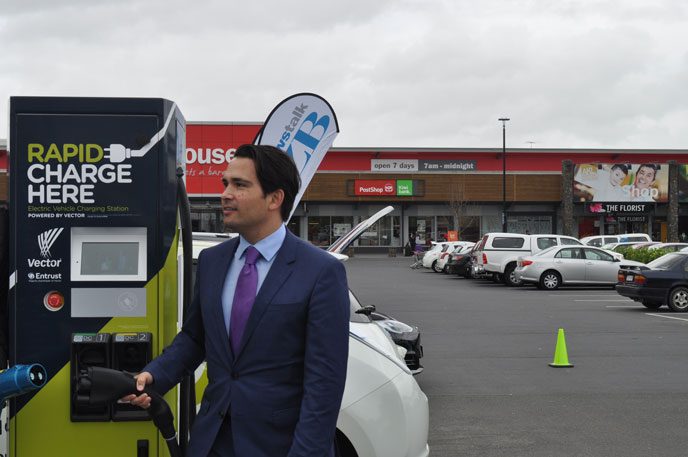
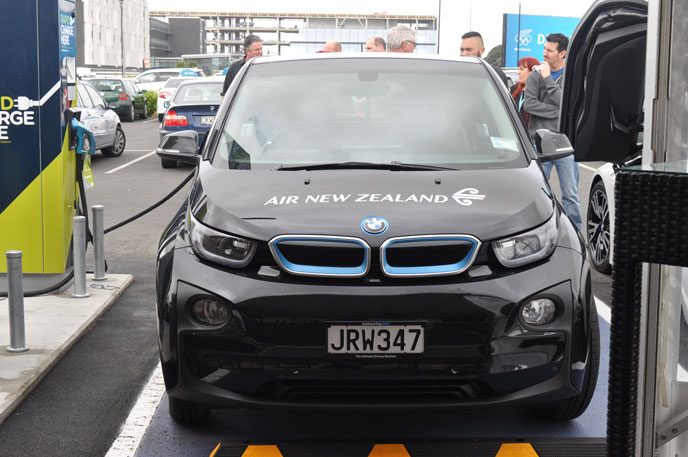
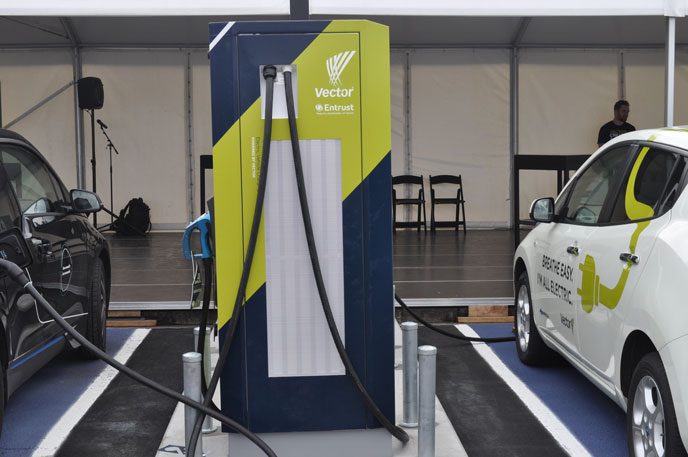
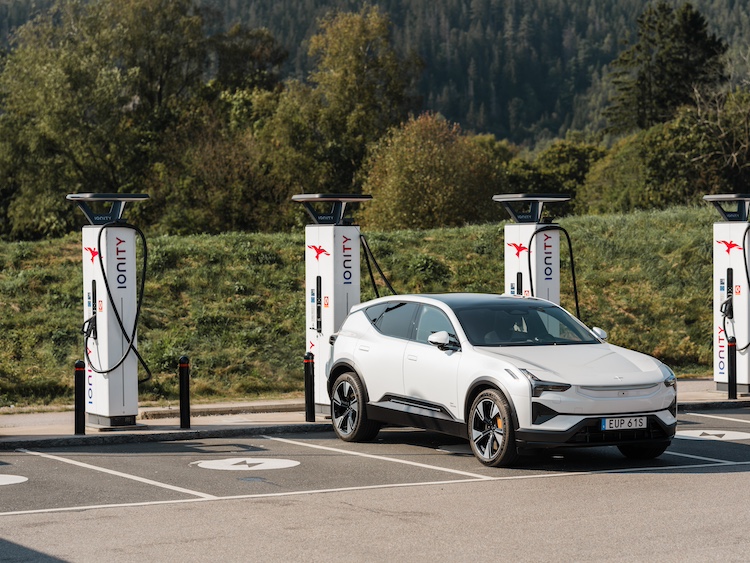
Vector opened new fast-charging facilities in the carpark of Auckland Airport’s shopping centre this week, bringing the number in the immediate area to seven.
Vector’s chief executive Simon Mackenzie said Vector welcomed the opportunity to work alongside Auckland Airport to provide infrastructure to support sustainable travel and the government’s electric vehicle programme.
Minister of transport Simon Bridges said the launch attests to sustainability leadership from all involved in building the charging network.
He pointed out that the airport hub is a gateway for millions of passengers coming in each year as well as a burgeoning business centre, necessitating the stations to quell range anxiety for EV drivers.
“I used to say EVs are the future but the future is here now,” he said. “The case for this is incredibly strong as EVs are environmentally friendly and equivalent to 30c a litre – cause for pride in homegrown clean energy in one’s vehicle.
“Government in association with the transport ministry will be instrumental in accelerating the uptake of EVs to 64,000 by 2021. That entails doubling the fleet every year from 4000 to 8000 to 16,000 – the further it goes the harder it becomes, entailing a raft of work and measures to achieve objectives.
“I’m excited and looking forward to Drive Electric Week from September 10 to 18.”
Auckland Airport chief executive Adrian Littlewood said the stations form part of a wider commitment to sustainability that has already seen Auckland Airport make significant reductions in its waste, water and carbon footprints and be included in the global Dow Jones sustainability index for the last four years.
Mackenzie elaborated that Vector is encouraging sustainable travel choices by installing EV charging infrastructure around the Greater Auckland area, facilitated by an interactive map on the company’s website, which is optimised for mobile use. “Customers can have the confidence that they will never be far from a charging station, which takes 15 to 30 minutes, for their EVs.”
He pointed out that Telsa’s investment in its Gigafactory, a lithium-ion battery factory under construction and in production at the Tahoe Reno Industrial Centre in Storey County, Nevada, US – primarily for Tesla Motors – will make the cost of batteries decrease significantly, which is important as their cost affects purchasing decisions.
The factory is set to churn out both battery cells and packs under one roof at massive scale using a high density of machines cobbled together to slash production costs. The factory’s blueprint will more closely resemble an advanced computer chip as opposed to a traditional battery plant.
“Tesla is forecasting a reduction from $300 a unit to $100 by the early 2020s,” said Mackenzie. “Moreover, this energy will also be used on a large scale for common network purposes.
“This will fundamentally change the energy sector’s traditional cost model.”
Mackenzie added that uptake of EVs will be contingent on how quickly things transition. “New Zealand is already a large manufacturer of non-fossil fuels, now even looking at hydrogen fuel cells, which are the source of a lot of development overseas.
“The question remains as to how the energy can be delivered; not only through a network but through people starting to use solar panels to generate their own energy and then store it to charge their electrical appliances and provide power to their homes.”
He stressed that uptake also depends on an increase in the purchase of EVs from the secondhand market, which is being encouraged by government.
“As people see more of the vehicles around and experience how fantastic they are to drive as well as their level of comfort across the range of models, the more they will adapt to it,” he said. “They are not gimmicky!
“Conceptually I don’t think there’s a big difference in residual value between an engine needing to be reconditioned and the residual life of a battery and whether it has to be replaced. It’s really about customers learning how the technology operates and being comfortable with it.”
Mackenzie is part of an EV advisory committee set up by government tasked with finding solutions to meet its objectives and promulgating information appropriately.
Vector’s EV charging programme has been made possible with the support of majority shareholder Entrust, via a fund which has historically been used for undergrounding projects in the Entrust district. This has recently been extended to include new technology such as solar and battery and EV chargers.

Join the conversation (1)
What about Bi-directional flow charges etc. Nissan Leak 2021 has the capability