
Autonomous driving tricky in some areas

A Mercedes-Benz autonomous test vehicle facing some unusual challenges in Australia will learn what New Zealand has in store from December.
An Intelligent World Drive saloon based on the S-Class series is testing automated driving functions on five continents over five months.
Test drives forming part of that project include Mercedes-Benz Australia’s own test vehicle based on the E-Class, going since March and about to take in New Zealand road traffic conditions.
Australia is one of Mercedes-Benz’s core markets, so the E-Class – equipped with the new S-Class software, has been covering more than 20,000km between Perth, Melbourne and Brisbane while working closely with the company’s research and development centre in Germany.
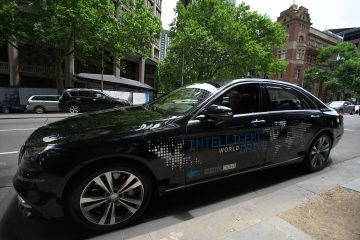 It has collected valuable information on Australian traffic practices and road signs, and tested digital map data. From December, this E-Class will face the specific challenges posed by road traffic in New Zealand.
Kangaroos and other animals, hook turns (turning off to the right from the left-hand lane) and flashing traffic signs are among challenges automated and autonomous vehicles face in Australia.
Mercedes-Benz started the Intelligent World Drive at the Frankfurt International Motor Show (IAA) in September to gather global insights into real-life traffic conditions, ending in January 2018 at the Consumer Electronics Show in Las Vegas.
Australia’s road traffic system increasingly uses electronic displays fitted with LED lighting for variable speed limits, simple symbols and letters. The display can change within fractions of a second, presenting a major challenge for digital camera performance and digital mapping data which enable automated driving functions such as active speed limit assist.
The “hook turn”, found only in Melbourne to control turning off roads also used by trams, requires a vehicle’s sensor system to detect and interpret it correctly.
Also unusual when compared with European or American road traffic is the extremely high number of animals crossing Australian roads. Many accidents involve emus, koalas, wombats or kangaroos. Sensors such as cameras and radar systems must detect the animals in good time and calculate their exact distance. Roos jumping up to 1.5 metres and reaching 60km/h are a particular problem.
The S-Class test car has a headlamp prototype featuring Digital Light technology with a non-dazzle continuous high beam in HD quality using chips with over one million micro-mirrors, and therefore pixels, per headlamp. It achieves ideal light distribution in all driving conditions and can also project light tracks onto the road to communicate with its surroundings.
The Australian S-Class test drives will be followed in December by tests in South Africa, where pedestrian detection will play a significant role.
In seven years, Mercedes-Benz has held about 5100 test drives around the world with 175 test vehicles for validations of driver assistance systems. This was assessed over some 9.5 million kilometres in Europe, the USA, China, Australia and South Africa.
Autonomous driving is one of the four strategic areas which form part of Daimler AG’s strategy under the acronym CASE – Connected (networking), Autonomous, Shared and Services (flexible use) and Electric.
Join the conversation