
Canada likely first to all EVs

Canada is expected be the first country to commit to all electric vehicles as soon as this year.
That’s according to new research by CarMoney which analysed the top economy countries by GDP with net-zero targets to uncover how many countries are on track to achieve their EV goals set out in the Paris treaty.
Electric car sales in Canada will outweigh internal combustion engine (ICE) cars as soon as this year, taking up 55% of the market share., making it the first country to meet net-zero targets based on electric cars alone, says CarMoney.
By 2026, Canada is predicted to be the first country to fully commit to electric passenger cars with zero ICE car sales, and a huge 278,081 EV sales.
This is nine years earlier than Canada’s EV mandate in which all passenger vehicles and light trucks sold after 2035 will be electric zero-emission vehicles.
The US is close behind Canada with EV sales exceeding ICE cars by 2024, says CarMoney.
The US government plans to make half of all new car sales electric by 2030, however, forecasting has revealed they could meet this target as early as 2024, with EVs taking up 55% of new car sales.
If the predicted trajectory of ICE and EV sales is to continue, the US could stop selling ICE cars by 2027, putting them on track to meet 2050 targets, CarMoney adds.
“Even sales of electric buses have grown exponentially, from 2021 to 2022 sales increased by 63% with 3912 sales in 2021, and 6359 in 2022.”
The UK lags behind, in spite of having an ICE ban target five years earlier than most, says CarMoney.
In spite of having a ban on sales of new ICE cars in 2030, five years earlier than Canada’s ban, the UK marginally lags behind Canada, and the US – a country with no official ICE ban, it explains.
New EV sales are predicted to surpass gas-powered cars in 2025, two years behind Canada, and one year behind the US.
However, although the UK falls behind the US, sales of ICE cars are forecasted to stop one year earlier than the 2030 ban.
In 2028, EV sales are predicted to take up more than 90% of the market share, and by 2029 this is estimated to be 100%.
South Korea has the slowest adoption rate of EVs, according to CarMoney.
“In 2022, EVs only share 6% of the passenger car market.
“In 2030, this is still low at 26%. Electric cars will only take over until South Korea’s government ban of new gas-powered car sales in 2035.”
Climate Action Tracker, an independent project that tracks government climate performance against the Paris Agreement, notes that South Korea is making progress in climate change mitigation but lacks the speed to meet the agreement.
The country is one of the world’s most fossil-fuel-reliant economies.
Recently the South Korean government had to cut its targets for reducing emissions in the industrial sector, with the new plan meaning that sector will only have to cut its emissions by 11%, instead of 15%.
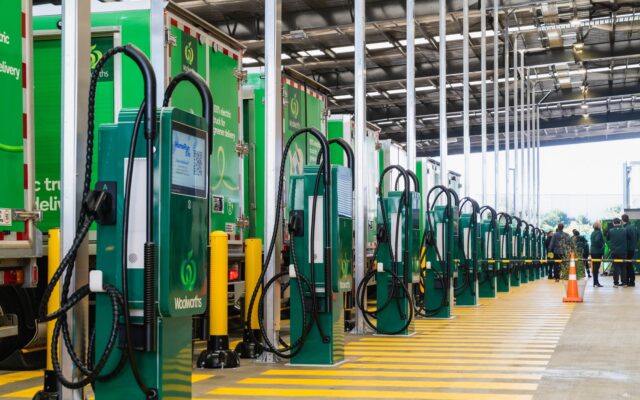
Other key CarMoney findings include that Italy has the second-best charging infrastructure with one EV per charger, Germany is predicted to have the worst charging infrastructure with 54 EVs per public charger in 2050 and the UK has the second worst public charging network with 35 EVs per charger in 2050.
Car Money calculated the average year-on-year growth from 2019-2022 for new passenger cars, and 2019-2021 for public chargers.
Data was sourced from the International Energy Agency, EV Universe and the International Organisation of Motor Vehicle Manufacturers (OICA), to predict the growth percentage of electric cars, ICE passenger cars, and public chargers up to the year 2050.

Join the conversation