
CAV technology to deliver on road safety

This story first appeared in the December issue of EVtalk – CLICK HERE to download the magazine FREE
With deaths and serious injuries on New Zealand roads climbing since 2013, it is vitally important that transport agencies work across the four pillars of the Safe Systems Approach to reduce this unnecessary toll on the community.
Supporting and encouraging the use of connected and autonomous vehicle (CAV) technologies on the road network will play an important part in achieving New Zealand’s road safety strategy objectives and ultimately the goal of zero deaths.
Several publications cite that CAVs have the potential to yield up to a 90-95% reduction in crashes. This estimate is built on the premise that human error is estimated to be a factor in 90% of today’s road accidents.
However, vehicle manufacturers and original equipment manufacturers (OEMs) have flagged several issues with deploying advanced driver assistance systems (ADAS) in Australia and New Zealand (ANZ).
In several cases OEMs have opted to turn potentially lifesaving technologies off due to issues experienced on ANZ road networks. This has meant New Zealand road users are potentially missing out on the considerable road safety benefits that ADAS could deliver.
It has become imperative that road practitioners understand how the systems function and what can be done to optimise their use.
Importantly, since the start of 2018, the Australasian New Car Assessment Program (ANCAP) requires a vehicle to have at least one automated safety feature, such as traffic sign recognition (TSR) capabilities, to make it eligible for a five-star safety rating.
In considering different levels of vehicle automation it is acknowledged that systems used in Level 2 vehicles may not be the same in Level 5 vehicles. For example, a Level 2 vehicle may use a camera-based system to read road signs while a Level 5 vehicle may only rely on a connected database in the cloud.
Engineers and planners will need to be aware that, during the transition period to full automation, they will be planning and operating roads for vehicles that are human only control (Level 0/1), partial human control (Level 2/3 vehicles) and no human control (Level 4/5).
With the current average age of a light vehicles in New Zealand at 14.3 years and at least 20% over 20-years-old, we could easily assume that:
If the last Level 0 vehicle (human only driver) was sold in 2025, that vehicle will likely still be on the road in 2040; and
If the last Level 2 vehicle was sold in 2030, that vehicle could still be on the road in 2045.
The purpose of these two points is to highlight that work done now by engineers and planners in supporting and enabling Level 2 vehicle technologies, such as TSR, will likely still be relevant 25 years from today.
In 2017, Arup – on behalf of AustRoads and several transport agencies (including the New Zealand Transport Agency) undertook a study into the: Implications of Traffic Sign Recognition (TSR) systems for road operators.
With transport agencies in New South Wales estimating that 39% of deaths on their roads can be attributed to excessive and inappropriate travel speeds, supporting and encouraging automated systems that assist the driver to adhere to safer speeds could deliver significant road safety benefits.
TSR is an in-vehicle technology which attempts to read and interpret roadside traffic signs. Vehicle manufacturers are moving towards enabling speed assistance and automated driving using TSR systems.
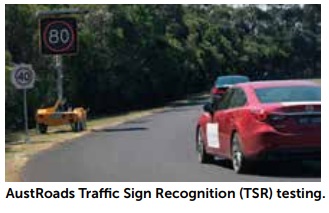 A key aim of the study was to identify the root causes of TSR technology issues.
Evidence was collected through three sub-investigations: A literature review of TSR technology and international traffic sign standards; stakeholder interviews with vehicle manufacturers and key stakeholders for traffic sign standards and guidelines; and via on-road and off-road tests and evaluations.
Some of the key findings made by the study included:
Electronic signs: These could not be consistently read by TSR systems during on-road trials. Stakeholder interviews indicated that the refresh rate of signs and variability of pixel illumination could vary between brands and designs. Further analysis is now under way to better understand the root cause of electronic sign readability issues which will feed into a consistent standard for electronic signs in the ANZ region.
Education & awareness: Programmes are required to educate traffic managers on the impacts, on TSR system performance, of inconsistent sign installation and placement at roadworks zones. Generally, a greater reinforcement is required of the legal status of some traffic signs. Signs should not be fitted to other vehicles, tramways, roadside objects such as wheelie bins or buildings, where they are visible to passing traffic.
School & conditional signs: TSR systems struggled with school zones and conditional signs. Options for resolving this issue require further policy consideration of costs and public acceptance, they could include deploying more variable speed limit signs (VSLS) on high speed, high traffic roads or introducing permanent 40km/h zones where free traffic speeds cannot achieve more than 40km/h.
OEMs: Though there are several infrastructure solutions, enhancements to TSR systems are required by OEMs to ensure they are more spatially aware and can avoid scenarios where signs located on nearby roads are incorrectly interpreted.
Visit this link to download the full report for free or watch our live webinar on the study.


Join the conversation