
Contact Energy walks the talk in switching over its fleet
This story first appeared in the July issue of EVtalk – CLICK HERE to download the magazine FREE
A leading New Zealand electricity generator and retailer, Contact Energy, is well on track to electrifying its fleet, with the charge being led by the organisation’s geothermal operations near Taupo.
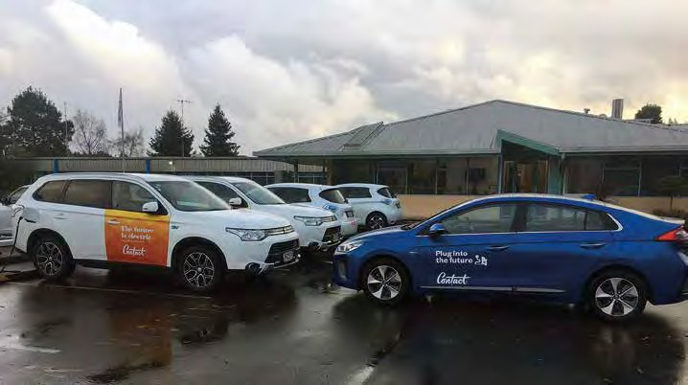
“We have nine EVs at the moment,” fleet manager Chris Girling says.
These comprise four Mitsubishi Outlander PHEVs, three Renault Zoes, a Hyundai Ioniq and a Gen 1 Nissan Leaf.
The EVs are on a three-year lease deal which Girling sourced himself with the help of EV Central in Taupo.
EV Central imports new EVs directly from the United Kingdom at very favourable prices when compared to New Zealand new equivalents, Girling says.
While Contact Energy has a number of vehicles in its national fleet, Girling is responsible for the largest number with 33 in the geothermal fleet.
They are pool vehicles for use during day-to-day duties.
“All staff can just book them for their work use,” Girling says.
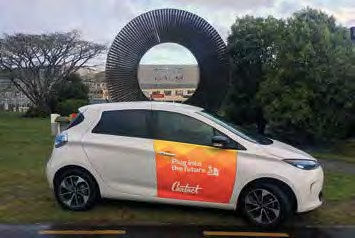
A Renault Zoe.
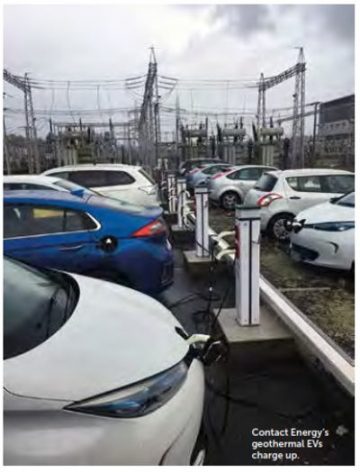
The EVs are mainly used by office staff to travel between local stations and are predominantly charged on Contact Energy’s premises.
“We have four Rolec double chargers, each having a type 1 and a type 2 lead and two Delta type 1 chargers,” Girling says.
“Nearly all our EVs use type 2 charging except for the Outlanders and the Leaf.
”
These are also available for staff to charge their own EVs free, although only one of the 140 staff has an EV at present.
Girling expects EV ownership among staff to increase.
He says the EV market has seen considerable change in the past 18 months, with a wider variety of EVs with greater range becoming available.
“Once people understand and appreciate the benefits of driving an EV then more and more become interested.
”
The 24kWh Nissan Leaf has a more unusual role in Contact Energy’s fleet.
It’s stationed at Taupo airport and used by Contact Energy people visiting the Wairakei power station site, about a 40km round trip.
Girling says that using the Leaf instead of rental vehicles is saving about $42,000 annually.
It uses a charging station at the airport, which has a second charger that can be used free by the public.

Once some of the EVs come to the end of their three-year lease there’s an option for Contact Energy staff to pay the residual amount owing and keep the vehicle.
A trial of a Nissan eNV200 40kWh van is being considered when it becomes available in New Zealand later this year.
If the trial is successful, the vans could replace some of the fleet’s Ford Ranger utes.
Girling says while four-wheel drive utes are a must in certain circumstances, most of the two-wheel drive utes generally only carry two people and some tools on sealed roads, therefore a light EV van could well be a suitable alternative.
He says most of these vehicles would cover about 60-70km a day.
The fleet Ioniq and Zoes have been used to travel much further, such as to Rotorua and back to Taupo, able to do the 160km round trip comfortably on a single charge.
There is still some “range anxiety” among some of the staff, so a trial run to Napier is on the cards to help alleviate this.
Girling is confident that with the greater variety and improved capabilities of EVs coming on the market Contact Energy will easily meet its EV target.
Visit contact.co.nz
for more information.

Join the conversation