
Daimler plans global e-truck network
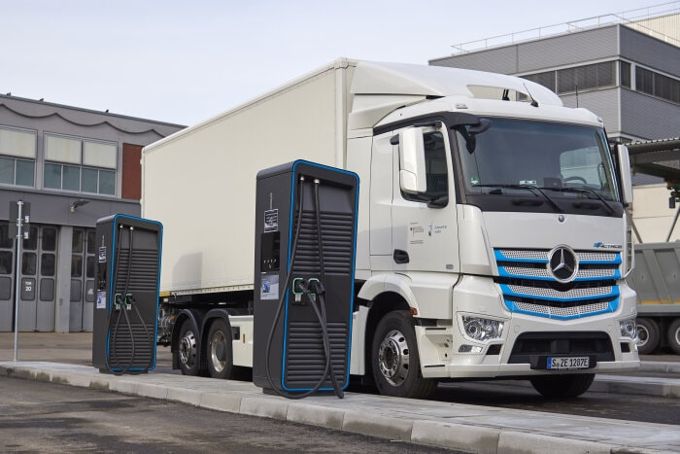
Daimler Trucks is launching a worldwide initiative to establish charging infrastructure for battery-electric trucks.
The initial focus of the E-Mobility Group is on charging stations installed at the depots of customers and also brings together power grid operators, energy suppliers, charging hardware manufacturers and charging software providers.
It aims to promote shared infrastructure solutions for truck customers within the network.
The focus of activities is currently on the United States and Europe and Japan will be the next market to follow.
The first workshops are underway with joint pilot projects for setting up charging infrastructure at truck depots in planning and implementation stages.
Daimler’s E-Mobility Group head Gesa Reimelt says the project is “taking an active role in driving forward the change towards battery-electric road transport – also beyond our e-trucks and consulting services”.
“To this end, we are now setting the course for the development of the necessary infrastructure together with all those involved.”
“Through our intensive dialogue with customers, we are building up comprehensive expertise in all aspects of the power requirements and infrastructure needs of fleets.
“In the first step, we find out which power supply is available at a customer’s depot and which operating processes have an influence on power charging.
“With our newly launched ‘eTruck Charging Initiative,’ we are now translating these findings into suitable offers together. This includes, for example, supporting truck customers in the selection of the energy supplier and of the charging-station provider, as well as providing the appropriate charging software,” Reimelt says.
“From our point of view, depot charging at the truck customers’ depots represents the first and most important step towards entering the world of e-mobility.
“This means that the current fields of application for electric trucks in connection with urban distribution traffic can already be covered and the infrastructure can be ideally adapted to the logistics provider’s processes, resulting in the lowest possible charging costs.
“Depending on how the trucks are used, opportunity charging is also an option for extending their range, for example at the unloading or loading point where the electric trucks stop anyway. In the future, public charging at publicly accessible stations along central transport routes will also be an important aspect – a comprehensive charging infrastructure maximizes the operating range of battery-electric trucks,” Reimelt says.
The Mercedes-Benz eActros, with a range of around 200 km, is being tested by customers in Germany and Switzerland. In the US, the medium-duty Freightliner eM2 and the heavy-duty Freightliner eCascadia are also currently undergoing practical tests with customers with series production planned for 2021.
As part of a small series, more than 150 electric Fuso eCanter light-dutry trucks are already in use with numerous customers in Japan, the USA and Europe.

Join the conversation