
Drone delivery: Publicity stunt or game changer?
This story first appeared in the November issue of EVtalk – CLICK HERE to download the magazine FREE

Drone delivery’s short-term potential might have been exaggerated but the technology has a long-term future, particularly within the trend to automate as much as of the logistics chain as possible. But patient investment in research and development, trials, constant negotiation with regulators, and wholesale re-organisation of distribution points and practises will be needed..
IDTechEx research director Dr Khasha Ghaffarzadeh outlines the situation in his report “Drone delivery: Publicity stunt or game changer in instant fulfilment?”
The idea of drone delivery sharply divides commentator opinion.
Some dismiss it as a mere publicity stunt and others consider it a game-changer that will bring near-instant product fulfilment to e-commerce, stripping traditional shops of their last major differentiator.
In our report Mobile Robots and Drones in Material Handling and Logistics 2017-2037, we have analysed the technologies that are emerging in the last-mile delivery space, including drones and autonomous mobile ground robots (or droids).
We provide a quantitative picture of the market evolution, in unit numbers and revenues, over a 20-year period (2017-2037).
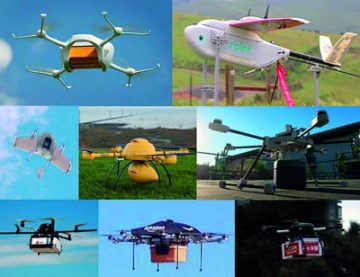 We do this for all aspects of mobile robotics in material handling and logistics also including autonomous trucks and light vans, autonomous mobile material handling carts and vehicles (forklifts, for example), AGVs and AGCs, and mobile picking robots. We provide technology assessments, detailed 20-year market forecasts, and company overviews/profiles.
In this article we paint a big picture of how we see the emergence of drone delivery.
Industry changing character
Drone delivery must be first viewed within the context of the emerging drone industry.
This has grown rapidly with the market leader’s income reaching $1.5 billion per year. The industry is now led not just by Made-in-China but also by Designed-in-China.
The market is, however, in the midst of changing its character.
The consumer drones’ hardware platform has become rapidly commoditised with prices falling, according to our data, by more than 60% in the past two years or so.
The growth in unit sales is yet to catch up, causing many to feel the pain and laying off staff en masse. Investment levels are also showing signs of slowing down, prompting concerns about a potential crash after the hype.
Investment rose nearly 50-fold between 2012 and 2016, exceeding $450m in 2015.
Investment peaked in 2015 as industry moved past the hype and as the platforms commoditised. New opportunities beyond platforms are now sought in specialised software, hardware components such as sensors and drone services.
The new prevalent strategy is to pivot towards commercial drones. The drones will be higher performance and potentially application-customised, leading to higher prices.
This will hold true in the medium-term but there will be no escaping the ultimate fate – hardware platform commoditisation. The rise of prosumer drones – with prices already pinned down close to the consumer end – attests to this.
The lasting source for value, however, is likely to be found (a) in specialised vertical (or application) focused software (apps) providing a higher value service; or (b) in specialised hardware components such as sensors or batteries.
Indeed, the value of drone-enabled services will only grow as the installed base of drones expands, creating an infrastructure that will support large-scale service deployment. This is not much different to the rise of mobile phone apps that followed the large user base.
Drone delivery is also part of the same trend – pivot towards specialised hardware platforms enabling a new commercial service.
The idea of drone delivery entered mainstream media in late 2013. Around that time, drone delivery of e-commerce parcels was first demonstrated while, in parallel, drones successfully delivered medicine to remote areas.
Since then numerous deliveries have been made, partnerships announced and substantial sums invested (Matternet and Zipline raised US$12.95m and US$41m, respectively).
Despite that, the industry is still in its infancy.
What compensates for poor productivity?
Drone delivery faces critical challenges.
Individual drones offer limited productivity compared to traditional means of delivery – for example, consider a van delivering 150 parcels in an eight-hour shift).
They can only carry small payloads and battery technology limits their flight duration, constraining them to around a 30-minute radius of base, and the downtime needed for re-charging/re-loading further lowers their productivity.
But that, in our view, is not a showstopper. Fleet operation will compensate for poor individual drone productivity.
The unit cost of drones will be substantially lower than, say, a van, enabling the conversion of a few, highly productive vehicles into many small drones with high productivity at the fleet level.
It will require a further major reduction in hardware costs for commercial drones but if the past is our guide, this will be inevitable, as explained earlier.
As a general point, autonomous mobile robotic technology is causing a paradigm shift in the way we envisage many commercial vehicles. Take an unrelated example – tractors in agriculture. Here, the traditional design objective has been to make the tractor bigger and faster to amplify the productivity of the driver.
Autonomous mobility can up-end this by converting a few, fast, heavy tractors into a fleet of many slow, small driverless agrobots. This process has begun and drone delivery can be viewed as part of this same long-term trend.
Limited payload is also not a showstopper because, according to Amazon statistics, around 85% of packages weigh below 2.26kg.
And the fall in delivery costs and time for customers is changing purchasing habits. Frequent orders of small items are replacing that big infrequent order. That matches well to the strong points of drones.
The limited range is also not a showstopper even in suburban areas where customers do not live close to a distribution point.
It will, however, mean a gradual yet wholesale change in the location of warehouses, with more placed closer to end customers, or the use of large mobile drone carrier vans.
The former is already happening in the background and the latter has also been demonstrated as a concept.
Will safety concerns stop the show?
The most critical challenge is safety.
It can indeed be a showstopper and will almost certainly limit the market scope to sparsely populated areas.
Regulatory framework is already being relaxed for commercial drones but it still rightly continues to put brakes on large-scale deployment of beyond-line-of-sight commercial drones.
Indeed, there are many accidents waiting to happen – mechanical failure causing crashes, software failure leading to early release of payloads, etc.
Safety concerns will be a major damping factor. Together with technology limitations, they will limit the market scope.
Indeed, our market roadmap suggests that drones will initially be constrained only to deliveries to remote areas.
Technology evolution will enable them to move towards deliveries of urgent vital items and then towards places with low sprawled-out population densities.
High-density apartment urban environments will remain largely out of reach.
Our forecast model and technology roadmaps show delivery drone sales will remain limited to a few hundreds a year between now and 2027/28.
Demand will then start to take off, reaching sales volumes exceeding 50,000 a year by 2038.
Thanks to accumulation effects, we expect to see major drone delivery fleets in operation within our 20-year forecast period.
Long-term future
Drone delivery is still in its infancy. Its short-term potential has been exaggerated.
However, the technology has a long-term future, particularly within the context of the bigger trend to automate as much as of the logistics chain as possible.
Its realisation will require patient investment in research and development and trials, constant negotiation with regulators and wholesale re-organisation of distribution points and practises.
The technology will therefore be a loss marker for its main users for years to come. But the ultimate grand prize of instant fulfilment will drive the industry forward.
Players will have no choice but to continue to sink money into distribution technology or services, viewing them as marketing expenses in their battle for market share against each other as well as against traditional stores.
Despite their ultimate rise, however, drone delivery will remain only a small part of the much bigger commercial drone story.
Visit www.IDTechEx.com for more information on the report Mobile Robots and Drones in Material Handling and Logistics 2017-2037.

Join the conversation