
E-buses a US$25 billion market in 2030 – IDTechEx
The bus market is at a crossroads.
A pressing need for cities to improve air quality, alongside commitments by many governments to address climate change, are powering plans to deliver zero-emission city bus fleet solutions.
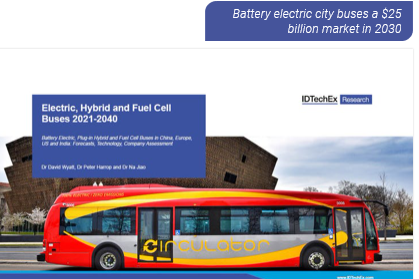
During the next decade these efforts will see major cities increasingly get zero-emission buses, a new report Electric, Hybrid and Fuel Cell Buses 2021-2040 from IDTechEx explains.
It suggests uptake of zero-emission buses over the next 20 years will primarily be of pure battery electric models (BEVs), with plug-in hybrids rapidly losing market share and fuel cell electric buses taking only a small fraction of the market as they fail to offer the same total cost of ownership benefit as BEV buses.
There remain significant cost barriers as well as uncertainty on how the necessary supply of cheap green hydrogen will be produced to deliver FCEVs promised environmental and economic credentials, IDTechEx technology analyst Dr David Wyatt says.
On a CO2 footprint basis, the use of grey hydrogen (hydrogen produced from fossil fuels with no CO2 capture), makes no sense. Currently 96% of hydrogen produced is grey hydrogen, he says.
Progress is being made on the development of FCEV buses; however, they are chasing a moving target, Wyatt believes.
With falling battery pack prices, improving charging infrastructure and bus schedule/charging optimisation for BEVs, by the time sufficient hydrogen infrastructure is available to enable the widespread commercialisation of FCEV buses their deployment may be limited to long daily mileage applications, he adds.
China has led the world in bus electrification and will continue to do so over the next 20-years, Wyatt says.
However, as a result of the subsidy phase-outs and the increasing saturation of electric buses in Tier 1 cities, IDTechEx projects electric bus sales in China will stabilise at a lower level than during the subsidy boom years, after the biggest decline yet in 2020 from the COVID-19 pandemic.
While Chinese OEMs will no longer receive large subsidies in China, the support has already established a world-beating cost base and technology which is spreading to other countries, Wyatt points out.
For example, Europe sold more than 1800 electric buses in 2019, up from around 750 in 2018, with BYD and Yutong as key suppliers.
“As the Chinese electric bus market saturates, we expect to see an increased presence of Chinese bus OEMs in other bus markets around the world.”
California has committed to an all-electric transition of its public bus fleet by 2040.
The second phase of India Faster Adoption and Manufacturing of (Hybrid) and Electric Vehicles (FAME) scheme recently sanctioned the deployment of 5095 electric city buses, and the Indian government has ambitious aims to convert the nation’s fleet to EVs.
Many other countries are looking to BEV city buses – several South American nations have been purchasing them primarily from Chinese OEMs. In Russia, Moscow has ordered electric buses from the Russian OEMs Kamaz and GAZ Group; and in Korea, Hyundai has been developing electric buses to help reduce traffic congestion and air pollution.
The IDTechEx report examines how the bus is being reinvented and looks to the rise of a new category, the autonomous shuttle.
This report also forms a part of the broader EV and energy storage research at IDTechEx, track the adoption of EVs, battery trends and demand across more than 100 different mobility sectors in Electric Vehicles 2020-2030: 2nd Edition
.

Join the conversation