
EECA’s latest EV funding
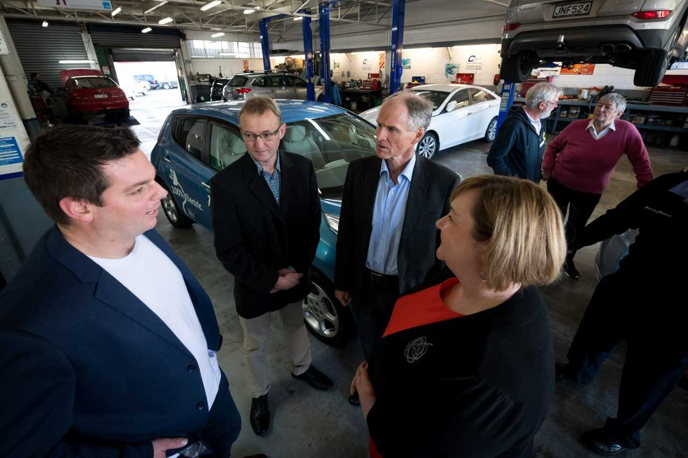
Nineteen projects promoting electric vehicle uptake benefit from the $3.87 million in the Energy Efficiency and Conservation Authority’s latest funding round announced by energy and resources minister Megan Woods.
The money from the low emission vehicles contestable fund administered by EECA covers up to 50% of the project’s cost, the rest met by the applicant.
Twenty-two more public fast chargers will be installed to build EV drivers’ confidence in the accessibility of State Highway 1 between Christchurch and Blenheim; the Southern Scenic tourist route; and the Kapiti and Horowhenua coasts.
ChargeNet NZ has received three grants. It gets $65,500 to install two 50kW DC fast chargers at Ward and Cheviot.
The company also receives $164,500 as part of a partnership for a dedicated electrified Southern Scenic tourist route.
It’s also part of a trans-regional partnership which will see nine fast chargers installed in five towns in the Horowhenua-Kapiti area.
About $130,000 will go towards three cloud-connected metered fast-chargers in Ohakune, Taumarunui Railway Station and Otorohanga.
Plenty of heavy vehicle projects are represented, including $763,668 for NZ Bus to install charging infrastructure for pure electric buses in Wellington and $255,000 for WEL Services to convert a 10-tonne truck to electric.
Eastland Port in Gisborne gets $177,000 for a heavy electric truck to tow a water trailer suppressing dust in port and log yard sites. Tranzit Group has picked up $367,000 for a fully electric bus in Palmerston North.
Shore Trips and Tours gets $134,250 for an electric coach to take cruise ship passengers to Te Puia and Hobbiton from Tauranga.
Quest Apartment Hotels receives $147,550 for advanced multi-charger systems across 29 apartment complexes.
And Jucy Group gets $365,000 for its collaboration with several tertiary institutions to design lightweight fit-out options and other range extension initiatives for 10 electric camper vans.
Toi Ohomai Institute of Technology receives $48,972 for two electric seven-seater staff vans to connect its Tauranga and Rotorua campuses, with associated charging infrastructure.
New Zealand Post gets $100,425 in conjunction with contractor Grant Bagshaw to prove the suitability of electric vans on a rural post delivery network, with three Nissan e-NV200 vans due to operate in the Katikati region for a year.
NZ Post also gets $61,150 to produce a practical checklist for companies to assess the likely impact of installing EV chargers on building electrical infrastructure and energy costs.
Countdown Supermarkets receives $387,500 for fully electric delivery vehicles in Auckland, Wellington and Christchurch.
Wellington-based Kaibosh Food Rescue gets $69,999 to replace its old trucks with two electric vans for daily food rescue and redistribution.
And in Auckland, Cityhop receives $326,809, with a plan to add 20 low-emission vehicles to its car sharing scheme.
Christchurch City Council picks up $43,470 to deploy an electric van for its newly re-established central city parks maintenance team, while The Environment Centre Hawke’s Bay has $13,000 for an EV van.
Funding for round five opens on August 15.

Join the conversation