
Electrification a wake-up call for OEMS – IDTechEx
Few of the giant car makers have shown urgency in transitioning away from the internal combustion engine (ICE) while newcomers involved with vehicle electrification have made huge gains.
So says an IDTechEx report from technology analyst Luke Gear, adding the automotive market is set to decline again.
He believes EV orders (not deliveries) have increased so that “if OEMs do not wake up now, they never will”.
Gear adds that fuel cells are losing the battle in most mobility segments.
“The main problem fuel cells face competing with batteries is additional and highly inefficient energy-conversion steps; first converting water to H2 with electricity, and then the fuel cell itself is roughly 60% efficient when converting H2 back to electricity and water for the vehicle (large heat losses).
“As a result, fuel cells need an abundance of renewable energy to operate cleanly, which in itself will be a challenge.”
Gear says FCEVs still need a sizable battery for high-power and energy harvesting, have moving parts (meaning more maintenance); hydrogen charging infrastructure costs many multiples of a fast charger; they rely on expensive raw materials; there is no roadmap to economies of scale, and more.
Other factors include China removing its fuel cell subsidy beyond 2020, fuel cells losing opportunities in heavy-duty segments and that the VW Group head said the serious inefficiency of fuel cells denies them a place in its agenda.
“It is confusing, then, that Toyota has prioritised fuelled vehicles in the form of fuel cell and hybrid versions, mainly with cars.”
Fuel cells have had some positives this year, Gear says.
“Hyundai announced a fuel cell truck, and Nikola announced impressive partnerships along with 14,000 pre-orders. However, the positives generally reflect the wider trend that fuel cells are only competitive in long-haul heavy-duty segments. And this is just for now — even here there will be tough competition with batteries (Tesla Semi).”
In 2019, newcomers made most of the running with pure electric vehicles that are rapidly becoming the only show in town, Gear says.
“Tesla stormed ahead in a declining car market, underpinning growth in the US and Europe by selling vehicles the giants still do not offer.”
More futuristic start-ups made a giant splash – Sono Motors taking more than 10,000 orders for its all-over solar car (US$200 million), and Lightyear taking more than US$10 million in orders for its high-priced, advanced solar cars.
“Despite these wins, it is still a serious challenge moving from prototypes and hype to serial production. Thus far, Tesla is the only survivor.”
Of the giants, VW Group continued its u-turn, promising to invest more on pure electric vehicles than any other company, Gear says, also pointing to Hyundai’s EV plans.
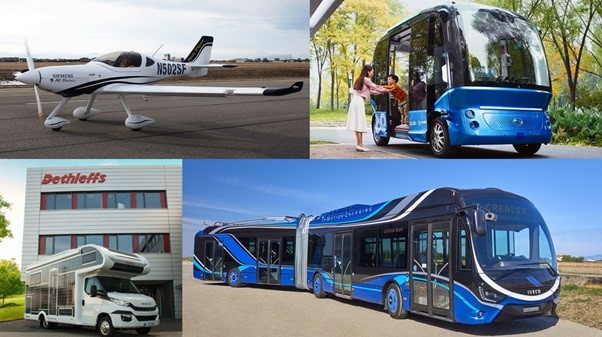
Bye Aerospace, with Tesla-like technology in an aircraft, took 1100 orders for its two and four seaters.
“For crewed electric aircraft, the growth is looking very promising for replacing both small piston and turboprop aircraft. But the real value in this market lies in the larger commercial jets, which are a long way off having the necessary energy density and regulation for success in electric propulsion. There is also the excessive hype of eVTOL designs (or sky taxis), despite the promise of this becoming a booming reality in just a few years the truth will likely be very different outside of very specific examples. Don’t expect to see them flying over your cities for a long while yet.”
Tesla immediately took 250,000 pre-orders of cybertrucks in the first week (more than US$10 billion), treading on Rivian’s toes (Rivian earlier took 100,000 orders of tailored pure electric delivery trucks from Amazon), Gear says.
“The true test for both Rivian and Tesla will be the entry of Ford into the electric pickup market. “With Rivian’s R1T pickup scheduled to begin deliveries in late 2020, and the Tesla Cybertruck set to roll of the assembly line in late 2021, Ford have been stirred into action and are now promising an electric version of their Ford F-Series by 2022.
“Having been slow to act on the rise of EV, Ford’s all-electric F150 could be a game changer.”
Sensibly, Hyundai has gone into buses and Tesla may follow suit after its formidable truck entry, Gear says.
China’s auto giants are also in buses and trucks – a good strategy in the face of ‘peak car’.
Komatsu in construction, agriculture and mining (CAM) is impressive with leadership in such things as autonomy, supercapacitor power regeneration, hybrid and pure electric excavators.
CNH is another dark horse doing amazing electric things.
There is a trend to monster pure electric buses without rails and with only intermittent power pickup thanks to large batteries on board (variously called road trains, trams or bus rapid transit). In 2019, CNH Iveco landed some nice orders for its award winning Crealis with non-stop power pickup.
In 2018 and 2019, Skoda Electric has tested a new electric trolleybus model in Plzeň, Czech Republic.
In 2019, Volvo Group, now 10% China-owned, makes construction/mining vehicles and buses and trucks. It took Europe’s largest order by value for pure electric buses in Gothenburg, Sweden.
So buses and trucks could well be a bigger business than cars in 15 years, Gear says.
In addition, construction, agriculture and mining vehicles are one business that should not be overlooked, with a market value for EVs easily exceeding US$150 billion by 2030.

Join the conversation