
EV batteries – recycle or second life?
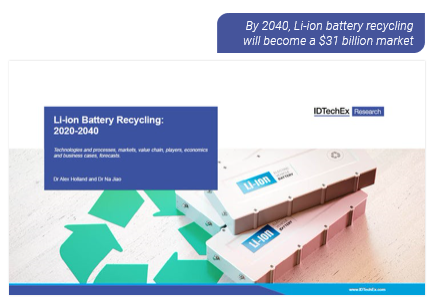
Lithium-ion battery demand is expected to grow in coming years as EV adoption increases, with the associated battery recycling market worth US$31 billion annually by 2040.
Meanwhile, as they begin to reach their EV end-of-life an exponential growth of retired li-ion batteries coming out of vehicles will happen, says an IDTechEx report, Li-ion Battery Recycling 2020-2040.
This year about 14GWh or 102,000 tonnes of li-ion batteries are retiring from EVs annually. With the rapid adoption of EVs, the total amount of EV batteries reaching end-of-life is expected to reach 7.8 million tonnes per year by 2040.
When an EV battery is reaching its EV end-of-life, the battery can either be repurposed for a second life in alternative applications such as energy storage or recycled to obtain the raw materials.
Unlike batteries used in consumer electronics such as our laptops and mobile phones, the batteries retired from EVs can still retain 70%-80% of their initial capacity.
Those batteries cannot satisfy the requirements for use in EVs anymore, for example when the loss of battery capacity limits driving range, but they can provide sufficient capacity for less-demanding applications such as stationary energy storage in their ‘second-life’.
Global EV manufacturers including Nissan, Renault, BMW, Volkswagen, BYD and more have been exploring various usage scenarios for second life EV batteries from residential to commercial and grid-scale energy storage applications. However, there are companies such as Tesla which claim that all of their EV batteries will be directly recycled instead of being repurposed for a second life.
In theory, recycling is the least sustainable measure in a circular economy and should be the last step when the batteries cannot be used anymore, the report says. Therefore, retired EV batteries should be considered for remanufacturing or repurposing for second life before they are recycled.
In practice, however, many more factors are considered. A hot discussion around whether to recycle or repurpose a second life for retired EV batteries is also related to battery chemistry.
Lithium iron phosphate (LFP) is a popular chemistry used by Chinese EV manufacturers. It has been extensively used in the electric buses in China due to safety concerns. According to BYD, the leader of LFP batteries in China, second use of LFP batteries makes business sense. Unlike NMC or NCA batteries, the recycling value of LFP batteries is relatively low because it does not contain high value metals (US$9/kWh for LFP versus US$25/kWh for NMC 111 at current metal prices).
Besides, LFP has better cycle life and safety performance which is a priority for stationary storage rather than high energy density. These make second life an attractive option for retired LFP EV batteries.
Whether retired EV batteries have a second life or not, all those batteries will need to be recycled in the end anyway. Recycling provides a crucial solution to raw material supply insecurity and price fluctuations. Through recovering critical raw materials from li-ion batteries, manufacturers can shield themselves from supply disruptions and generate additional revenue streams.

Join the conversation