
EV camper research project launched
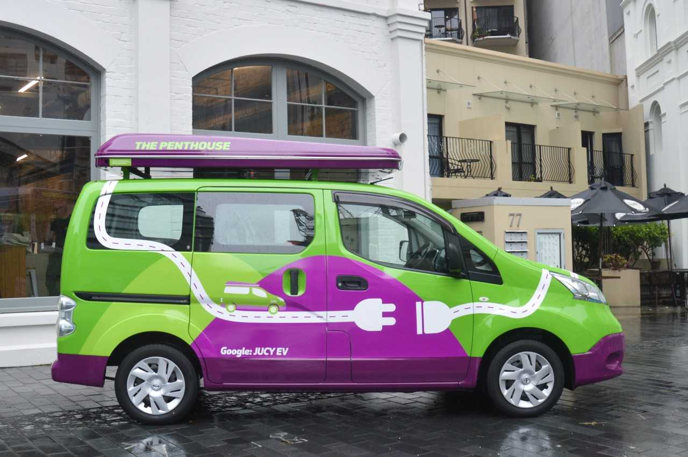
A new research and development project to improve the efficiency of electric vehicles has been launched in New Zealand.
Tourism company Jucy is working with Massey University academics to produce the next generation of electric campervans following a five-month road trial by two French students.
“The trial data showed us there are some key areas we need to focus on, including reducing the weight of the vehicle and increasing the capacity of the battery to allow us to get 200km from each charge,” Jucy chief operating officer Dan Alpe says.
“Our collaboration with industrial design specialists at Massey University will see us completely redesign the interior and exterior of our campervans using new materials which are lighter and more aerodynamic.
“We will also be looking at the integration of solar panels and developing more advanced battery technology to find new ways to get more distance from each charge – without travellers having to compromise on features such as air-conditioning to conserve power,” Alpe says.
“There is also a significant education role to be undertaken about electric vehicles – particularly among campgrounds and tourist centres who need to understand the importance of EVs in the future of New Zealand tourism.”
The five-month trial saw an electric campervan, a Nissan e-NV200 24kWh, driven more than 13,000km to 45 destinations across New Zealand. Data recorded the cost and availability of charging infrastructure, as well as local attitudes towards and awareness of EVs.
The two Parisian eco-tourists, Heloise de Bokay and Solene Trinquet, drove the prototype electric campervan around the country to test it under real-world conditions, and produce a documentary for the European market on their sustainable tourism experience here.
While they were able to traverse most of the country efficiently, the trial revealed a number of shortcomings with EV infrastructure, Alpe says. He says these need to be addressed to provide a more seamless experience for tourists.
“One of the key findings of the trial was that in some parts of the South Island there are long distances in between vehicle charging stations which our current battery range can’t easily traverse.
“For example, there are no campgrounds between Blenheim and Kaikoura, let alone any charging facilities, and only two fast charging stations in the entire West Coast.
“This meant the tourists had to stop every 100km to charge for five hours and, in a number of cases had to knock on the door of a private household to ask to charge their vehicle overnight.
“There was also a significant cost variation in the cost to power the battery each time, with one campground wanting $45 just to charge the vehicle – compared to a $5-$10 cost at most fast-charging stations around the country.”
Alpe says international tourists expect to find a country which has embraced a sustainable philosophy. “It is clear that more work needs to be done for us to meet these expectations.”
Jucy intends introducing a larger fleet of electric campervans, including 10 for this summer.
“This new fleet of vehicles will need to go much further on a single charge to avoid tourists being stranded,” Alpe says.
Alpe says the trial showed centres with fast-charging stations become an essential destination point, and tourists will often want to shop while waiting for their EV to charge.
Jucy has recently applied for Government funding for R&D into new EV technologies.

Join the conversation