
Budget 2023 expands charging network
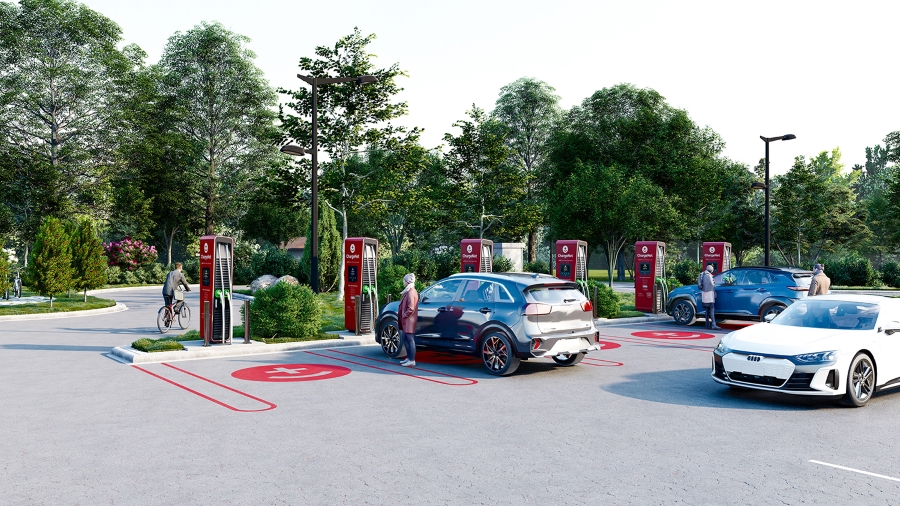
Major expansion of the nationwide EV charging network to deliver 23 charging hubs with the private sector is planned in Budget 2023.
Budget 2023 also funds between 600 and 1000 EV chargers in smaller rural communities’ with $30 million approved for this purpose out of a total of $120 million from a broader electric vehicle charging initiative.
“We’re making sure there are more locations for people to ‘tank up’ their EVs, with a nationwide network of public electric vehicle charging hubs, with multiple fast electric vehicle chargers,” says energy minister Megan Woods.
“We’ll also ensure rural and regional communities have more options to charge up EVs so a lack of chargers is no longer seen as a barrier to electric vehicle adoption as we decarbonise our energy system.
Transport minister Michael Wood says switching to EVs would be like buying petrol for 40c/litre, which will make a big difference for household budgets.
“We’re partnering with the private sector to build thousands of new EV chargers across the country,” he explains.
“This will expand the growing national network of EV charging hubs – each containing up to 20 chargers – to up to 23 hubs.
“This will see charging hubs every 150–200 kilometres on main highways, a public charger for every 20-40 EVs in urban areas, and public charging at community facilities for all settlements with 2000 or more people,” Wood explains.
Budget 2023 funding for the EV network expansion is $120 million over four years.
It’s also getting wheels turning faster on low-emission heavy vehicles like trucks and buses.
“We’re also announcing a fund to provide grants towards the purchase of low emissions heavy vehicles, including trucks, heavy vans and non-public transport buses,” says Megan Woods.
“Estimates show this will help get about 500 low emission heavy vehicles on to New Zealand’s roads, displacing fossil fuel ones. This transition could reduce operators’ fuel costs by up to 75%.”
About $30 million over three years has been set aside for clean heavy vehicle grants.
“The fund builds on the success of the Clean Car Discount and Low Emissions Transport Fund to support road freight operators to lower their emissions, and over time their operating costs,” Michael Wood adds.
Major investments will make roads more resilient, he explains.
“The severe weather events of this year have highlighted how crucial it is to invest in early preventative works to protect our transport network.
“We need to ensure that communities will stay connected as we see severe weather events become more common and damaging. These roads are lifelines for communities, particularly rural ones.
“A strong, resilient network will give certainty that emergency vehicles can get where they need to go as quickly as possible, goods and services can move in and out of regions, and people can stay connected with friends and family.
“A $279 million investment package for State Highways will focus on slip prevention, flood mitigation, and managing risk of sea level rise.”
Waka Kotahi NZ Transport Agency has worked with local communities to identify the highest risk areas.
This includes work on projects like slope stabilisation at various SH1 locations in Northland such as Long Hill, Saunders Road and Kaiwaka, flood mitigation on the Auckland motorway network, and managing the risk of coastal inundation on SH6 at the top of the South Island.
ChargeNet says the Budget EV charging announcement will help NZ transition to zero-emissions fleet
“ChargeNet plans to double the density of its network in the next three years, bringing everyday New Zealanders over 600 fast DC charging points,” says ChargeNet chief executive Danusia Wypych.
“We are already about halfway there, and over the next year we will open more than a dozen new sites co-funded through the Government’s Low Emission Transport Fund (LETF), administered by EECA (the Energy Efficiency and Conservation Authority). In the coming year, ChargeNet expects to commit to the same number of privately funded sites.”
Wypych says Government support enables private investment to ramp up and keep pace with EV uptake over the next four years.
“The Government’s announcement of $120 million over four years towards building light EV charging infrastructure could ensure the rapid adoption of zero-emissions vehicles can be supported with essential public charging networks.
“For every dollar the Government has invested with ChargeNet, we have provided three dollars of private capital.
“We don’t yet know how the fund will be structured or accessed, be we hope to see a diverse range of public charging infrastructure supported. If funding can be accessed by companies in a rational manner where they are required to demonstrate the need for co-investment alongside their own capital, we can support the rapid adoption of EVs for all kinds of Kiwi families.”
Wypych says supply needs to come before demand – “if we want more people to buy EVs, the chargers need to be there for them”.
“The network should be developed in anticipation of rapid demand increases for public charging infrastructure, not just what is commercially viable now.
“ChargeNet encourages the Government to develop a consistently available fund for public charging infrastructure for sites where investment is needed but will not be immediately profitable.

Join the conversation