
Fuel cell cars a commercial failure – IDTechEx
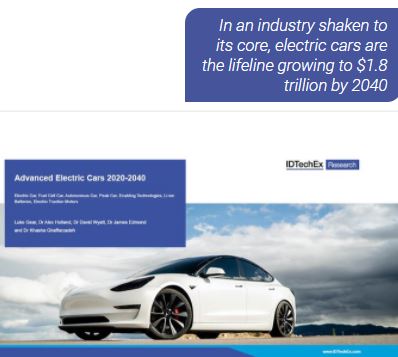
Fuel cell cars will continue to be a commercial failure for the next two decades.
So says the IDTechEx report Advanced Electric Cars 2020–2040 which forecasts fuel-cell cars globally through to 2040.
While fuel cell electric vehicles (FCEVs) have been on the table as the long-range zero-emission vehicles to challenge the battery electric vehicle (BEV), they have major drawbacks, according to the report.
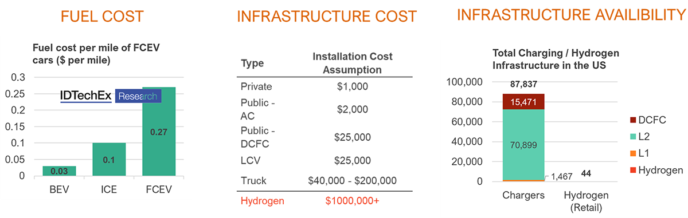
Currently, fuel cell cars cost over 1.6 times as much to buy and up to three times as much to run in fuel costs, depending on your location compared to the average internal combustion engine (ICE). In contrast, BEVs are increasingly reaching total cost of ownership (TCO) parity with ICE vehicles in different markets around the world today, the report suggests.
FCEVs rely on lithium-ion batteries for high power and energy harvesting, increasing costs (the Nikola One has a 250kWh battery).
Fuel cells have moving parts, which means maintenance costs can be higher than BEVs.
Batteries are heading towards million-mile life and 1609km range with 2-4C charging this decade – by the time fuel cell cars are affordable, batteries will have caught up and will be cheaper.
Fundamentally, it costs more energy to drive per kilometre using hydrogen than a battery because of the 60% efficiency with heat losses, in addition to using electricity from the grid to create green hydrogen.
IDTechEx estimates 54kWh of electricity is needed to produce 1kg of hydrogen (H2) from an electroliser, with a battery round trip efficiency of 90%.
One of the common arguments for fuel cells is that they can provide longer pure-electric ranges.
This advantage is being eroded by the sheer pace of innovation and research for li-ion batteries, the report says.
As it highlights, the top three fuel cell car models are the Toyota Mirai with 482.8km range, the Hyundai Nexo with 664.6km range, and the Honda Clarity with 508.5km range.
Yet earlier in 2020, Tesla revealed a 643.7km Model S (EPA), spurred on by healthy competition from rival Lucid Motors which later announced the Lucid Air BEV sedan would be the first production car with 804.6km electric range – with initial sales planned for Q1 next year.
And this is without considering potential for solar bodywork – the Lightyear One, on sale next year, achieves 745km range with only a 50kWh battery.
On the topic of range and range anxiety, it is also important to consider the ubiquitous deployment of charging infrastructure, IDTechEx says.
Currently, sufficient hydrogen re-fuelling infrastructure does not exist to make fuel cell car purchases tempting even for the early adopter, in part because they are an order of magnitude more expensive to deploy than fast electric chargers.
So why should we pay attention to fuel cells, IDTechEx asks?
“Well, they are not off the table yet in heavy duty long-range applications such as off-road, marine and long-haul trucking.
“The problem is, compared to cars, these are all relatively low-volume markets and will struggle to reduce costs quickly.
“Batteries also compete in these areas, which means the application would need to have very specific requirements which rule out a battery. For example, re-charging massive energy capacities (over 1MWh) in a few minutes.”
FCEVs will have wider uptake in certain countries with a strategy for a broader hydrogen economy, but this will be regionally isolated and not the global trend, the report says.
“It will also prove a disadvantage for automakers having to develop different zero-emission vehicles for different regions, particularly as start-ups focus purely on BEVs and set the bar high.
”In short – if a battery can do it, it is currently the best value option for the consumer and environment. And a battery can do it for cars.”
Further research on the hydrogen economy is in the IDTechEx report The Hydrogen Economy, Fuel Cells and Hydrogen Production Methods.

Join the conversation