
Global partnership formed for hydrogen trucks
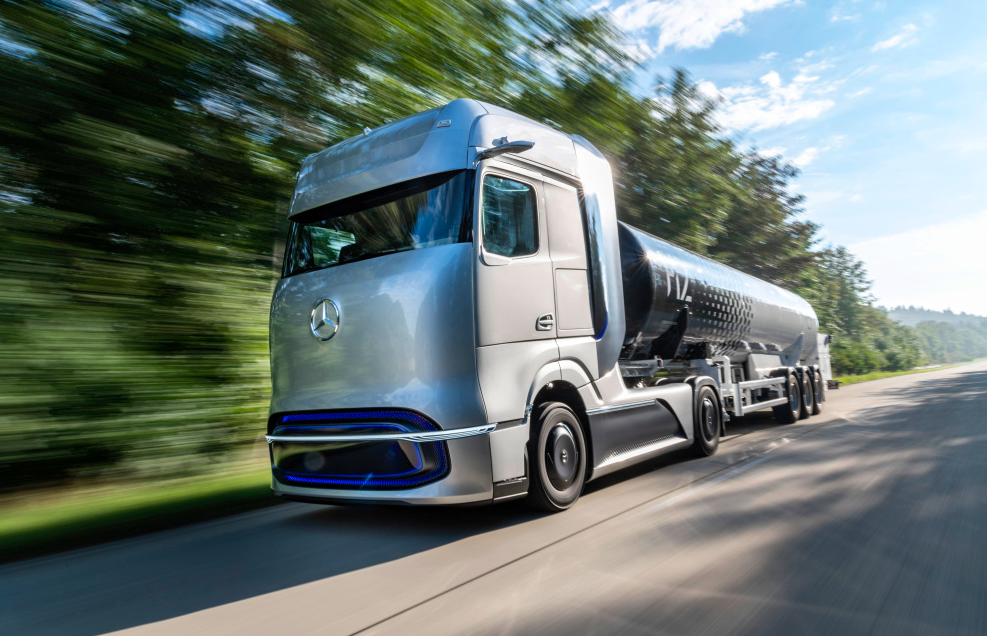

Daimler Truck AG, IVECO, Volvo Group, OMV and Shell are partnering up to help accelerate the mass-market roll-out of hydrogen trucks in Europe.
The companies have formed the H2Accelerate (H2A) initiative with the belief that hydrogen is an essential fuel for the complete decarbonisation of the truck sector.
Achieving a large-scale roll-out of hydrogen fuelled trucks is expected to create new industries such as zero-carbon hydrogen production facilities, large-scale hydrogen distribution systems, a network of high-capacity refuelling stations for liquid and gaseous hydrogen, and the production of the hydrogen fuelled trucks.
H2A participants will combine investments across the sector over the next 10 years. They say this will create the conditions for the mass market roll-out of hydrogen fuelled heavy duty transportation which is required to meet the European ambition of net zero emissions by 2050.
The decade long scale-up is expected to begin with groups of customers willing to make an early commitment to hydrogen-based trucking.
These fleets are expected to operate in regional clusters and along European high-capacity corridors with good refuelling station coverage. During the decade, these clusters can then be interconnected to build a pan-European network, the companies say.
Throughout the scale up, support from the public sector will be required. Under H2A, the participants expect to work together to seek funding for early pre-commercial projects during the first phase of the roll-out.
In parallel, the participants will engage with policy makers and regulators to encourage a policy environment which will help support the subsequent scale up into volume manufacturing for hydrogen trucks and a Europe-wide refuelling network for zero carbon hydrogen fuel.

Volvo Group
Volvo Group’s ambition is that 100% of its products are fossil fuel free enabled from 2040 with a gradual shift into electric, both battery and fuel cell electric.
In November, Volvo Group and Daimler Truck AG signed a binding agreement for a joint venture to develop, produce and commercialize fuel-cell systems.
“Climate change is the challenge of our generation and we are fully committed to the Paris Climate Agreement for decarbonizing road transport,” Volvo Group president and chief executive Martin Lundstedt says.
“In the future, the world will be powered by a combination of battery-electric and fuel-cell electric vehicles, along with other renewable fuels to some extent. The formation of the H2Accelerate collaboration is an important step in shaping a world we want to live in,” he says.
Shell
The Royal Dutch Shell Group is working to support the development of a global hydrogen market by creating an end-to-end business stretching from solar and wind to hydrogen production and finally supplying a growing range of customers in transport, heavy industry and other hard-to-decarbonise sectors.
“The prize is clear. By boosting scale in a big way, hydrogen fuelled trucks will need to become available to customers at or below the cost of owning and operating a diesel truck today,” Shell New Energies executive vice president Elisabeth Brinton says.
“This means truck customers will need to have access to a fully zero emissions vehicle with a similar refuelling time, range and cost range compared to the vehicles in use today.
“To achieve this ambition a clear regulatory framework is needed, including policies addressing the supply of hydrogen, hydrogen fuelled trucks, refuelling infrastructure and consumer incentives in a coordinated way,” she says.
Daimler Truck AG
In September 2020, Daimler Truck AG celebrated the world premiere of the fuel-cell concept truck Mercedes-Benz GenH2 Truck. It is conceptualised with liquid hydrogen for long-distance haulage operations with ranges of up to 1000 kilometres on a single tank of hydrogen.
Daimler Truck AG plans to begin customer trials of the GenH2 Truck in 2023 and series production is to start in the second half of the decade.
“The participant companies in H2Accelerate agree that hydrogen-powered trucks will be key for enabling CO2-neutral transportation in the future,” Daimler Truck AG board of management chairman Martin Daum says.
“This unprecedented collaboration is an important milestone for driving forward the right framework conditions for establishing a mass market for hydrogen-based trucking. It is also a call to action for policymakers, further players involved and society as a whole,” he says.
OMV
OMV produces and markets oil and gas, innovative energy and high-end petrochemical solutions. The company says sustainability is an integral part of its corporate strategy.
It supports the transition to a lower-carbon economy and has set measurable targets for reducing carbon intensity and introducing new energy and petrochemical solutions.
“H2Accelerate is playing a pioneering role and OMV is making an important contribution here,” OMV new energy solutions and HSSE senior vice president Angelika Zartl-Klik says.
“In order to achieve the climate targets, we will need any low-carbon technology. Hydrogen is an option for the climate-friendly mobility of the future.”
IVECO
IVECO designs, manufactures and markets a wide range of light, medium and heavy commercial vehicles, off-road trucks, and vehicles for applications such as off-road missions.
The company is investing in electric and hydrogen technology with driveline specialist FPT Industrial, also part of CNH Industrial, and through its partnership with Nikola Corporation.
“The widespread adoption of hydrogen fuel-cell technology in heavy-duty transport is a function of the necessary infrastructure,” CNH Industrial commercial and specialty vehicles president Gerrit Marx says.
“We also need very concrete projects to demonstrate with hauliers and other stakeholders in the industry that this solution is financially and operationally viable.
“The ground-breaking H2Accelerate collaboration will create the conditions for this to happen and accelerate the transition to zero-emission transport,” he says.


Join the conversation