
How can Tesla avoid rare earths?
Tesla announced at its Investor Day in March that its next generation of electric motors would contain no rare earth materials.
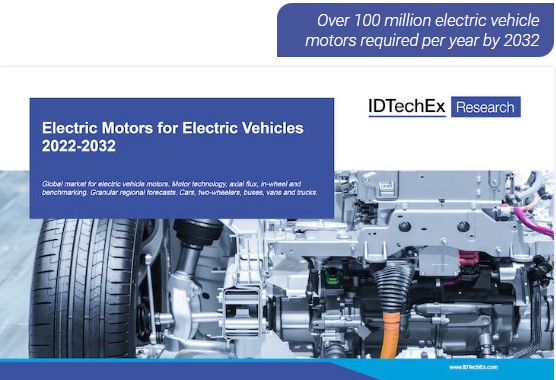
Given Tesla’s huge presence in the EV market, this could prove a significant transition for the design and sustainability of electric motors, says IDTechEx which takes a deep dive into the types of electric motors used in EVs as well as emerging alternatives like axial flux and in-wheel motorsi n its report Electric Motors for Electric Vehicles 2022-2032.
The report considers the EV market for cars, buses, trucks, vans, and two-wheelers across China, Europe, and the US.
Tesla’s early vehicles including the original Model S and X used an induction motor, where a copper or aluminium cage is used on the rotor (the rotating part of the motor), the report explains.
With the release of the Model 3 in 2017, it adopted the use of a permanent magnet (PM) motor where strong magnets are used to generate a magnetic field on the rotor.
Whilst Tesla retained an induction motor for its secondary drive unit (providing boosts of acceleration when needed), the switch to a PM design enabled greater efficiency and power density, IDTechEx adds.
In 2022, IDTechEx research found that more than 80% of the EV motor market was accounted for by PM motors.
“The downside to PM motors is the materials used to make the magnets, namely rare earths.”
This category includes materials like neodymium and dysprosium that are high-cost and have a geographically constrained supply chain, says IDTechEx.
China accounts for the majority of worldwide production which has historically led to price volatility. In 2011, China restricted exports of rare earths seeing an approximate price rise of 750% and 2000% for neodymium and dysprosium respectively.
Towards the end of 2020, prices started to rise again with the price in 2022 averaging about 2.6 times greater than in 2017.
In addition to the price concerns, there are environmental concerns. Rare earth mining can produce wastewater that acidifies the surrounding soil and groundwater. Radioactive and heavy metal waste is another potential by-product of rare earth mining.
Some manufacturers like Audi and Mercedes opted for induction motors to avoid PM concerns and BMW and Renault have gone for a wound rotor configuration.
These designs are typically heavier and less efficient overall, but great progress has been made to minimise these downsides., says IDTechEx.
“Whilst Tesla has suggested that its new motor will be rare earth free, crucially it is still a PM motor. “Some manufacturers, including Tesla, have steadily reduced the rare earth content, especially heavy rare earths, in PM motors. But to be rare earth-free, alternative magnetic materials like ferrite-based magnets or other alloys are required. Typically, these have a much weaker magnetic field, leading to a less power-dense motor.”
A few strategies Tesla could have taken to make this transition, but likely a combination of developments in magnetic alloys to improve field strength and increasing the size of the motor to provide similar outputs while taking a hit in power density, as drivers won’t notice unless it impacts performance or cargo space, says IDTechEx.
“We won’t know the exact details of the new design or the materials used until a later date, but it will be interesting to see if (and can) the rest of the EV market follow suit.”
Join the conversation