
Hyundai making first deliveries of Xcient fuel cell truck
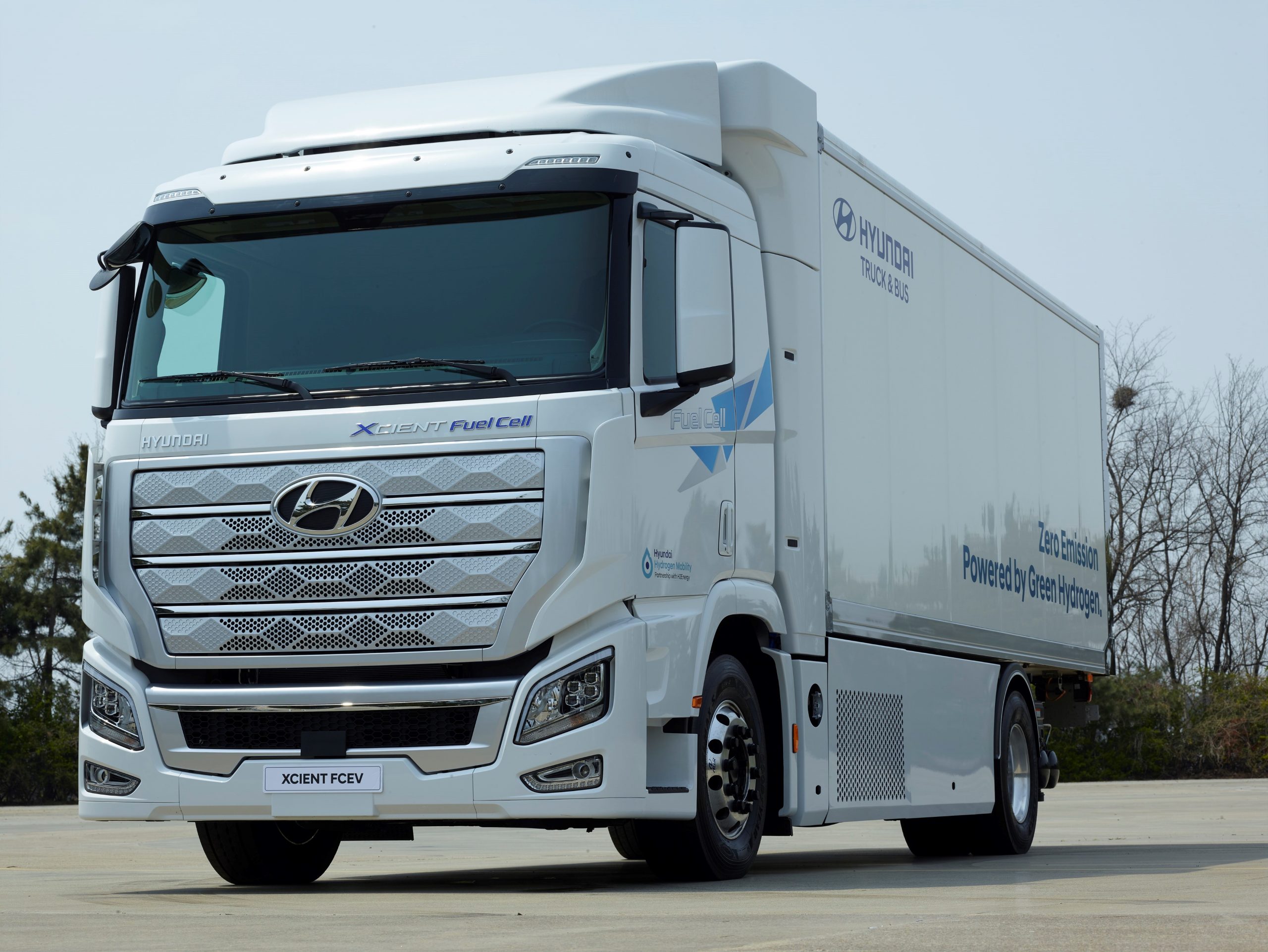
Hyundai Motor Company is delivering its first 10 units of the Xcient fuel cell truck to commercial fleet customers in Switzerland.
It’s the world’s first mass-produced fuel cell heavy-duty truck and the company plans to deliver 50 units by the end of this year and 1600 units by 2025.
Hyundai commercial vehicle division executive vice president In Cheol Lee says the Xcient fuel cell truck is not just a “future drawing board” project but “a present-day reality”.
“By putting this groundbreaking vehicle on the road now, Hyundai marks a significant milestone in the history of commercial vehicles and the development of hydrogen society,” Lee says.
“Building a comprehensive hydrogen ecosystem, where critical transportation needs are met by vehicles like Xcient fuel cell, will lead to a paradigm shift that removes automobile emissions from the environmental equation.
“Having introduced the world’s first mass-produced fuel-cell electric passenger vehicle, the ix35, and the second-generation fuel cell electric vehicle (FCEV), the Nexo, Hyundai is now leveraging decades of experience, world-leading fuel-cell technology, and mass-production capability to advance hydrogen in the commercial vehicle sector,” Lee says.
The Xcient is powered by a 190kW hydrogen fuel cell system with dual 95kW fuel cell stacks. Seven large hydrogen tanks offer a combined storage capacity of around 32.09kg of hydrogen.
The driving range between refuelling is about 400km, which was developed with an optimal balance between the specific requirements from the potential commercial fleet customers and the charging infrastructure in Switzerland. Refuelling time for each truck takes around 8-20 minutes.
Hyundai is also developing a long-distance tractor unit capable of traveling 1000km on a single tank equipped with an enhanced fuel cell system aimed at global markets including North America and Europe.
Joint venture
In 2019, the company formed Hyundai Hydrogen Mobility (HHM), a joint venture with Swiss company H2 Energy, which will lease the trucks to commercial truck operators on a pay-per-use basis, meaning there is no initial investment for the commercial fleet customers.
One of the reasons Hyundai chose Switzerland as the starting point is the Swiss LSVA road tax on commercial vehicles, which does not apply for zero-emission trucks. That nearly equalises the hauling costs per kilometre of the fuel cell truck compared to a regular diesel truck.
Hyundai’s business case involves using purely clean hydrogen generated from hydropower.
Switzerland is the country with one of the highest shares of hydropower globally, and can therefore deliver sufficient green energy for the production of hydrogen. Once the project is underway in Switzerland, Hyundai plans to expand it to other European countries as well.
Hydrogen leadership
In addition to the Xcient fuel cell trucks, Hyundai is also the manufacturer of Nexo, its second-generation hydrogen-powered SUV. By 2025, the company aims to sell 670,000 EVs annually, including 110,000 FCEVs.
In December 2018, Hyundai announced its Fuel Cell Vision 2030 long-term roadmap and reaffirmed its commitment to accelerate the development of hydrogen technology.
As part of this plan, Hyundai aims to secure a 700,000-unit-a-year capacity of fuel cell systems for automobiles as well as vessels, rail cars, drones and power generators by 2030.


Join the conversation