
Video: ID. Buzz lands with focus on personalisation

Volkswagen’s much-anticipated ID. Buzz has finally rolled into New Zealand showrooms, and it arrives with more than just its Kombi-inspired silhouette—this electric van is (mostly) going to be built to customer order.
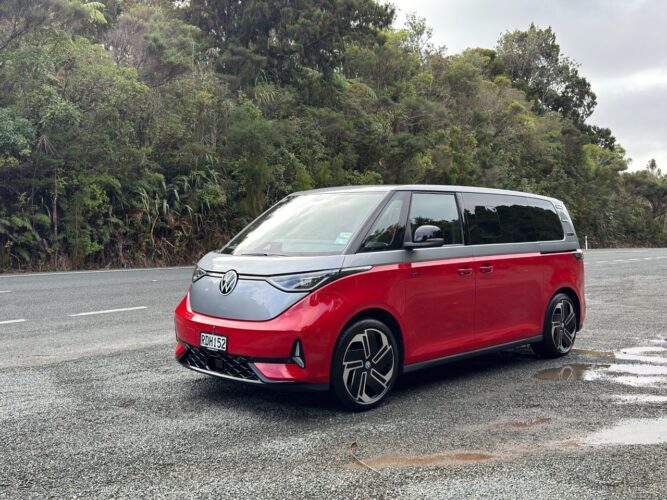
Instead of filling yards with identical stock, Volkswagen Commercial Vehicles NZ is asking buyers to configure their own Buzz, choosing everything from wheelbase and seat layout to paint and wheels. They have suggested it is a similar system to how Porsche sells its vehicles.
“Personalisation is key for the Buzz,” says Scott Duggan, national sales manager. “Right now for New Zealand there is over 2,000 variations you can build a Buzz.”
That bespoke ethos has paid off: of the first 35 vehicles in the country, not one is the same. The first two customer cars even headed straight to The Wrap Shop for customisations.
There is a commercial justification for the move too, with Volkswagen being one of a number of brands caught out with significant stock at the end of the Clean Car Discount period. It is a little more cautious now with the deliberate strategy to avoid overstock and resale discounts.
“We’re not going to have hundreds in stock,” Duggan explains. “When you have hundreds and hundreds of stock and then there’s distress selling… it hurts everyone.”
Customers can expect a lead time of about five months for their vehicle – though a few vehicles will be held in dealer stock. Production slots have been secured that can be modified right up to the actual build date. So the company pre-orders cars and allocates a slot when the customer orders.
Volkswagen expects to sell about 200 ID. Buzz units per year in New Zealand—modest numbers reflecting both premium pricing (from $129,990 for the Pro NWB to $149,990 for the GTX) and the more curated sales model. Those seem steep at first, but match them against the likes of Mercedes-Benz EQV ($166,350) or even the Kia EV9 ($105,990 to $134,990) and they aren’t that far out of the norm.
MEB based
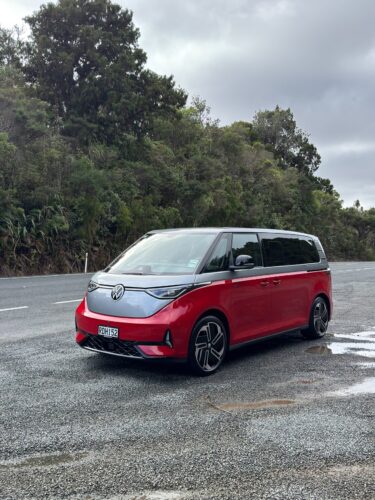
Built on the MEB platform, the ID. Buzz is available in four variants: the Pro (in normal and long wheelbase), the all-wheel drive GTX, and the Buzz Cargo.
The standard-wheelbase Pro and Cargo variants use a 77 kWh usable battery (82 kWh gross), with a rear-mounted electric motor delivering 210 kW and 560 Nm of torque. The long-wheelbase Pro and GTX upgrade to an 86 kWh usable battery (91 kWh gross). The GTX adds a second motor on the front axle for 4MOTION all-wheel drive and bumps power to 250 kW (134 Nm front and 560 Nm rear).
DC fast-charging is supported at up to 185 kW, taking the battery from 5% to 80% in approximately 30 minutes under ideal conditions. AC charging is rated at up to 11 kW.
WLTP range figures span from 382 km for the Pro NWB and Cargo, to 403 km for the long-wheelbase Pro and 396 km for the GTX.
Interior options
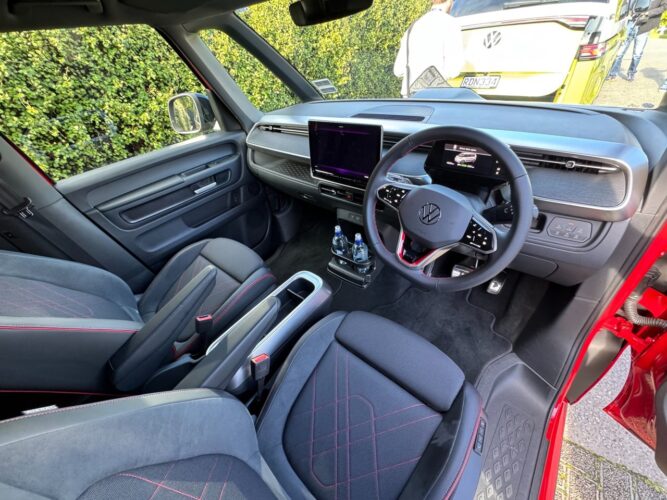
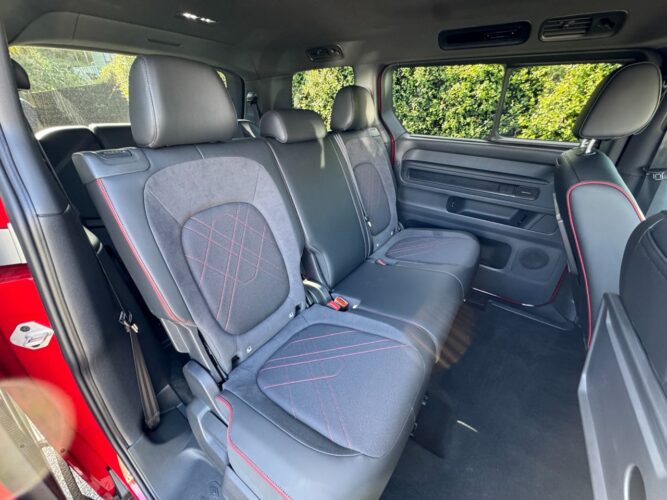
Inside, all passenger variants come standard with heated and massage front seats, a 12.9-inch touchscreen infotainment system, and ambient lighting with 30 colours. Up to eight USB ports are available in long-wheelbase versions, and wireless phone charging is standard. A panoramic electrochromic sunroof is optional.
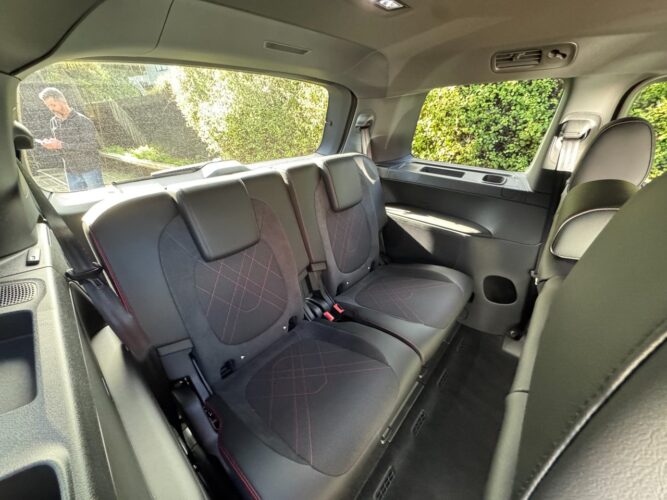
Seating layouts range from five to seven depending on configuration. The short-wheelbase Pro is available with five or six seats, while the long-wheelbase and GTX can be ordered with six or seven. Luggage capacity is up to 1,121 litres in five-seat configuration.
Meanwhile, the ID. Buzz Cargo shares the same drivetrain as the rear-drive Pro model and prioritises utility. It offers 3.9 m³ of cargo volume with capacity for two Euro pallets and a payload of up to 750 kg. Twin sliding doors are standard, and customers can choose between a standard tailgate or optional rear wing doors. Underfloor compartments offer secure storage for tools or charging cables, and accessory-ready flooring can be paired with racking systems from local suppliers.
Two battery sizes, two drivetrains
Four variants make up the range: the ID. Buzz Pro in short or long wheelbase, the dual-motor GTX, and the commercial-focused Buzz Cargo. The Pro NWB and Cargo models use a 77 kWh usable battery (82 kWh gross) with a 210 kW rear-drive motor delivering 560 Nm of torque. The Pro LWB and GTX upgrade to an 86 kWh usable battery (91 kWh gross). The GTX adds a second motor at the front for a combined 250 kW and 4MOTION all-wheel drive.
WLTP range is up to 403 km for the Pro LWB, 396 km for the GTX, and 382 km for the Pro NWB and Cargo. All variants offer 11 kW AC charging and support up to 185 kW on DC fast chargers, allowing a 5 to 80 percent top-up in roughly 30 minutes.
Volkswagen Commercial Vehicles NZ General Manager Kevin Richards says the delayed launch gave the team time to study the market and deliver a more complete offering. “That lag time has given us the opportunity to appraise the market and see what suits best… Almost having that delay has meant that we do get some insight as to what we can bring in.”
Join the conversation