
Nearly half of UK households using V2G in 30 years
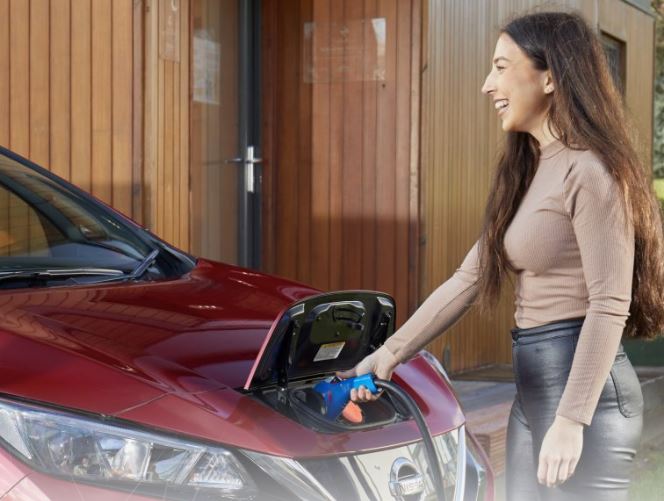
By 2050, up to 45% of households will actively provide Vehicle to Grid (V2G) services, according to National Grid ESO’s future energy scenarios.
V2G EV charging is considered important to achieve Net Zero – but most EV drivers may not be able to use it until at least 2025, says Electric Nation UK which starts a year’s trial of V2G in March 2021.
It says EVs can be linked together and put significant levels of energy back into the grid at peak times, like a huge decentralised power station.
Electric Nation says in the UK only Nissan BEVs like the Leaf and e-NV200 van can use V2G due to their Chademo charging technology.
The recently unveiled Nissan Ariya SUV, on sale in the second half of 2021, will feature CCS charging technology rather than Chademo, with bi-directional charging not expected to be available on this vehicle in Europe at launch but possibly coming later.
“Virtually all other EVs use the Combined Charging System (CCS) technology,” Electric Nation says. CCS promoters CharIN reckons it will be 2025 before it can support V2G, while EV manufacturers also need to bring their own products to market.
Electric Nation asked various experts about V2G’s future.
Such services could deliver up to 38GW of flexibility from 5.5 million vehicles, National Grid ESO’s scenarios says.
However, it expects the lowest estimate for the number of households actively providing V2G in 2050 will be 4.6%. That’s especially if V2G starts slowly, and includes a five to 15 year time lag between owning an EV and participation in V2G.
“The CCS pathway is understood and we don’t see too much V2G in the early part of the scenarios,” National Grid ESO principal advisor Marcus Stewart says.
“In 2050, take-up ranges from 5%-45% across the scenarios, with 45% being the ‘Leading the Way’ early delivery of Net Zero. The two other Net Zero compliant scenarios assume 11% and 26% in 2050. This reflects the uncertainty around the take up of V2G.”
Current Chademo chargers/vehicles will be compatible with existing and future ones, including the next-generation ultrahigh-power charging standard (Chademo 3.0), known as ‘ChaoJi’ (co-developed by the China Electricity Council and the Chademo Association).
This latest Chademo protocol enables DC charging with power exceeding 500kW.
CharIN, has a roadmap for implementing Vehicle to Home (V2H) and then V2G into the CCS standard by 2025, with ISO 15118 the key enabler.
There are many issues to overcome to achieve V2G, including grid capacity to handle and control Vehicle to Grid or Home (V2X) in a safe and secure way.
International standards must be agreed, then built into the communications hardware and software in the cars, the chargers and the grid.
BMW plans to provide 50 BMW i3 vehicles equipped with bidirectional charging technology for a year’s on-road trials starting early 2021.
Audi is researching bidirectional charging and says some grid integration applications will be available from 2022 while different use cases including V2H and V2G will be phased in later.
Its e-tron EV could supply a single-family home with energy for around a week.
Bidirectional charging focuses mainly on cases where homeowners use a photovoltaic (PV) system.
The EV can supply the entire house during phases when electricity prices are high or in a grid blackout.
Innovate UK has supported V2G projects totalling 46 million pounds, with partners including Octopus, OVO and Nissan.
The Electric Nation V2G project is being delivered by Western Power Distribution in partnership with CrowdCharge.
WPD’s DSO systems and projects manager Roger Hey sees V2G as a huge opportunity to reduce the extent and cost of upgrades to the electricity network and building new generation.
CrowdCharge chief executive Mike Potter adds: “Vehicle to Grid charging has the potential to offer significant benefits for electricity network operators and consumers, even with the move to CCS charging on most new EVs.
“However, unless the UK takes action following projects such as Electric Nation which are trialling and raising awareness of V2G, we could fall behind with exploiting the technology.”


Join the conversation