
New fuel cells announced

High-power direct borohydride fuel cells (DBFC) that operate at double the voltage of conventional hydrogen fuel cells have been developed by engineers at the McKelvey School of Engineering at Washington University in St Louis.
Liquid-fuelled fuel cells are an attractive alternative to traditional hydrogen fuel cells because they eliminate the need to transport and store hydrogen, the researchers say.
They can help to power unmanned underwater vehicles, drones and, eventually, electric aircraft — all at significantly lower cost, the research team adds.
These fuel cells could also serve as range-extenders for battery electric vehicles (BEVs), advancing their adoption.
Electrification of the transportation sector — one of the world’s largest energy consumers — is critical to future energy and environmental resilience, the team says.
That will require high-power fuel cells (either stand alone or in conjunction with batteries) to facilitate the transition to EVs, from cars and trucks to boats and airplanes.
The research team, led by Vijay Ramani, Roma B and Raymond H Wittcoff, has pioneered a reactant; identifying an optimal range of flow rates, flow field architectures and residence times that enable high power operation.
This approach addresses key challenges in DBFCs, namely proper fuel and oxidant distribution and the mitigation of parasitic reactions.
Importantly, the team has demonstrated a single-cell operating voltage of 1.4 or greater, double that obtained in conventional hydrogen fuel cells, with peak powers approaching 1 watt/cm2. Doubling the voltage would allow for a smaller, lighter, more efficient fuel cell design, which translates to significant gravimetric and volumetric advantages when assembling multiple cells into a stack for commercial use.
Their approach is broadly applicable to other classes of liquid fuel cells.
“The reactant-transport engineering approach provides an elegant and facile way to significantly boost the performance of these fuel cells while still using existing components,” Ramani says. “By following our guidelines, even current commercially deployed liquid fuel cells can see gains in performance.”
A senior staff research scientist on Ramani’s team, Shrihari Sankarasubramanian, says it’s “a game changer”.
A former member of Ramani’s lab, Zhongyang Wang, says: “With the development of this reactant-transport approach, we are on the path to scale-up and deployment.”
Ramani says the team is at the stage of scaling up the cells into stacks for applications in both submersibles and drones.
The technology is the subject of patent filing and is available for licensing.
The research was published on June 17 in the journal Cell Reports Physical Science.
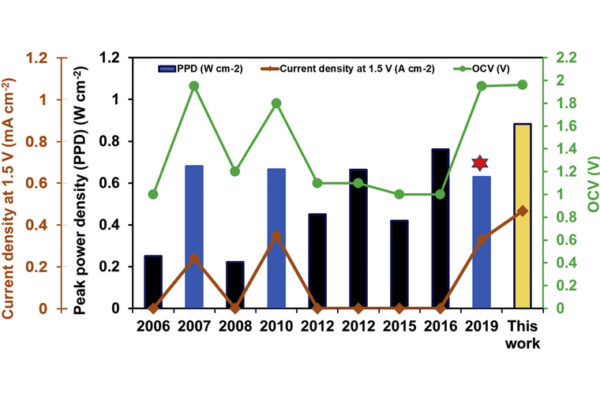
The figure summarises open circuit voltages of the representative DBFC performance in green and current density at 1.5 V in orange. DBFCs with peak power density at high voltage (>1 V) are represented by blue columns and those with peak power density at low voltage (<1 V) are represented by black columns. The present article’s work is highlighted by the yellow column. Graphic: Ramani Lab



Join the conversation