
New tech warns drivers to let emergency vehicles past
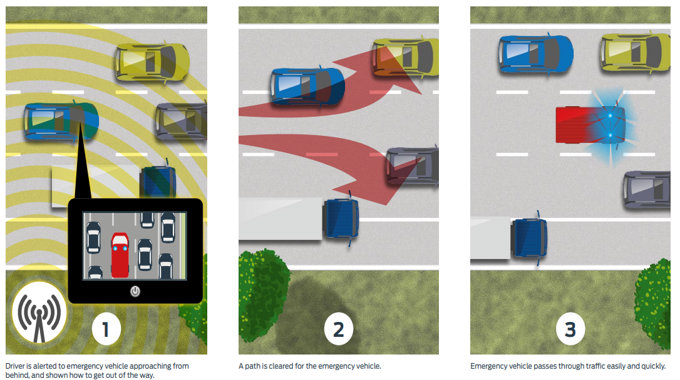
Connected vehicle technology that can automatically warn drivers of accidents ahead and show them how to get out of the way of emergency vehicles is being tested by Ford and Vodafone.
A prototype project which shows drivers how to create an “emergency corridor” so fire engines, ambulances and police vehicles can travel unhindered is aimed at improving accident victims’ survival rates.
Drivers confused in such situations can cause critical delays, with experts saying survival rates can be improved by as much as 40% if treatment is received four minutes quicker.
The system is being trialled as part of a 15 million euro project for the practical testing of new connected car technologies and automated driving.
“Connected and automated driving are key technologies of the future,” Ford of Germany chief executive officer Gunnar Herrmann says. “Ford has a long history of developing and testing vehicle to traffic infrastructure and vehicle-to-vehicle communications that can contribute to greater road safety and efficiency across the world. Together with Vodafone and in cooperation with the other companies involved, we will gain decisive insights on the Düsseldorf testing grounds to further advance the networking of vehicles.”
In an accident, “eCall” functionality, already available on the new Focus, can automatically call emergency services. It also enables occupants to push an SOS button inside the car.
Anticipating a future where all vehicles communicate with each other via mobile phone networks and embedded modems, Ford and Vodafone are exploring how “eCall Plus” might also inform other drivers of an accident ahead, across a range of up to 500 metres.
Attending emergency vehicles would also issue the warning, using in-car displays to show the correct “emergency corridor” formation.
On two-lane roads “emergency corridors” are created in between the two lanes by drivers pulling over to either side.
For more than two lanes the corridor depends on whether people drive on the right or left.
In countries where it is a legal requirement for drivers to take this approach, many drivers still do not comply.
In Germany, a survey revealed that almost half of all drivers don’t know how to form an “emergency corridor”.
The new technology complements emergency vehicle warning technology Ford is also testing.
This sends a signal from the ambulance, fire engine or police car directly to nearby drivers, so they will know the exact location of the vehicle and how far away it is.
“The digital revolution is bringing new forms of mobility which may help save lives on our roads,” Vodafone Germany chief executive officer Hannes Ametsreiter says. “When cars communicate with each other, our rescue teams get a clear path forwards, so they can provide the right help at the right time, in situations when every second counts.”


Join the conversation