
Nissan powers disaster recovery
Nissan’s Blue Switch project in Japan unlocks the energy stored in car batteries to help people hit by earthquakes, typhoons or other emergencies.
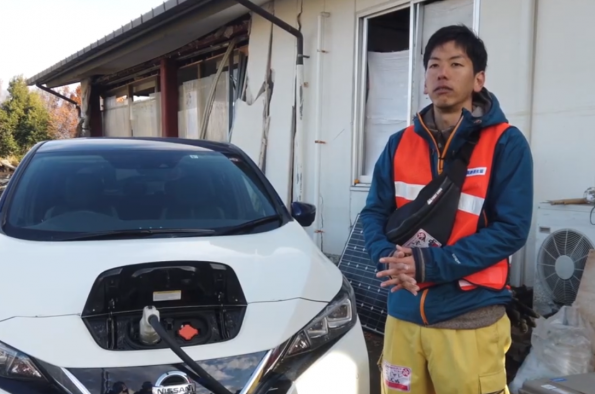
In the wake of Typhoon Hagibis in October 2019, those at a volunteer centre in Nagano Prefecture found an unexpected way to plug in – the white Nissan Leaf parked outside.
“It can charge tools, like an impact driver or a circular saw, which we use to remove walls or floors damaged by the flood,” says Ryosho Hara.
Electricity from the car’s battery is shared across the centre so that addresses of those affected by disaster are photocopied and maps are spread out in well-lit rooms.
“Without electricity, we can’t do anything,” adds Hara, “so it’s very helpful.”
The idea of using Nissan’s EVs during disasters was born during Japans’ 2011 earthquake and tsunami.
After nearly five million homes lost power then, Nissan provided a small fleet of first-generation Leafs to help.
In May 2018, the Blue Switch project was launched to demonstrate how EVs can be used as power sources for purposes beyond mobility.
Nissan has now reached a major milestone – 100 agreements signed with local governments and companies. Of these, 75 relate to how Nissan’s EVs can get straight to work the moment a disaster strikes.
It is trialling a “Re-Leaf” emergency EV and exploring how EVs can be used to share their energy – which include vehicle-to-grid (V2G) projects in New Zealand and Australia.
During those critical first hours and days, the EVs can move around disaster areas and deliver power where it’s needed most. It can recharge where the power supply has been restored, and then drive on to another hard-hit region.
At the Nagano volunteer centre in late 2019, the Leaf was driven around the community.
“It’s available to local people,” says Shuhei Kobayashi from the Nagano Volunteer centre. “When you are in an uncertain situation, even just having a light will relieve you.”
Next to Kobayashi, a suitcase-size device helped discharge the Leaf’s battery.
The Leaf plugs directly into a power converter for makeshift evacuation centres needing light and cooking facilities.
After a disaster, electricity is usually restored faster than fuel supply chains, making it superior to traditional diesel generators.
A Leaf e+ with a fully charged 62kWh battery can provide enough electricity to power an average Japanese home for up to four days, and charge 6200 mobile phones.
It can keep the lights and fridges on at a local convenience store, allowing people to buy food or other essentials.
With electricity down and air conditioning out, the heat was making it difficult for toddlers in Kisarazu City, Chiba prefecture, to have their midday nap – until a Leaf brought relief by powering some fans.
EVs have helped not only in Nagano, but also in Chiba Prefecture near Tokyo (hit by Typhoon Faxai), or during the flooding in Kumamoto in southwest Japan earlier this year.
“We’re using the technology now, for real solutions, to meet immediate needs,” Nissan executive vice president Asako Hoshino says.
Blue Switch was honoured at the 2020 Japan Resilience Awards for showing the potential EVs offer during emergencies, along with their role in energy management and the battle against climate change.
Nissan’s wider plan is to create a new “EV ecosystem”.
In the Netherlands, 148 Leaf batteries (mostly repurposed) help power a sports stadium.
Repurposed Leaf batteries are also being trialled in New Zealand.

Join the conversation