
Ocean ‘nodules’ best EV battery metals source – DeepGreen
Polymetallic nodules collected from the Pacific Ocean’s deep seafloor could provide better sustainable sources of minerals for EV batteries.
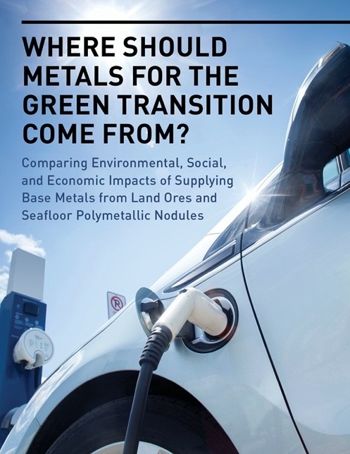
So says a white paper ‘Where Should Metals for the Green Transition Come From?’, exploring the environmental, social and economic costs of different sources of base metals required to transition the world away from fossil fuels.
Using a lifecycle sustainability analysis (LCSA) framework and standard lifecycle analysis (LCA) methodology, researchers compare two potential sources of minerals needed to manufacture EV batteries – ores mined from the land and the ocean nodules, finding in favour of the latter.
The study has been commissioned by DeepGreen Metals Inc., a polymetallic nodules exploration and development company on a mission to supply metals for the green transition with the least possible negative environmental and social impact and to accelerate the transition to a circular metal economy.
DeepGreen says it has developed a process for producing battery metals from polymetallic nodules with near-zero solid waste.
The findings suggest that, compared to land mining for battery metals, ocean nodules can deliver 70% less CO2e direct emissions, 94% less stored carbon at risk, 90% reduction in SOx and NOx emissions, 100% reduction in solid waste, 94% less land use and 93% less wildlife at risk.

The white paper comes from a coalition of leading researchers and scientists following a year-long study into the impacts of sourcing metals to produce battery cathodes and wiring for EVs.
As calls for a transition to renewable energy and electric transport grow louder in the face of global climate chaos, the study examines how we can source the massive amount of mineral resources required for a wholesale move away from fossil fuels with the least amount of damage to the planet.
Demand for certain EV battery metals is projected to increase by 11 times the current level by 2050, according to the World Bank, and shortages in nickel, cobalt and copper have been predicted to emerge as soon as 2025.
“The purpose of this in-depth research effort is to provide a substantive look into the impacts of different sources of the critical battery metals that make up the bedrock of the clean energy economy,” DeepGreen chairman and chief executive Gerard Barron says.
“The scale of the green transition is monumental, and the timeline is daunting. For Earth Day’s 50th anniversary let’s go deeper than mere calls for renewable energy and electric transport and have an honest conversation about the resources required to get us there.”
“We believe that polymetallic nodules are an important part of the solution. They contain high concentrations of nickel, cobalt and manganese—they’re effectively an EV battery in a rock.”
The LCSA study provides an in-depth comparison of the cradle-to-gate impacts of producing metals from land ores and polymetallic nodules, both sources of the nickel, cobalt, copper and manganese required to build one billion EV batteries.
“In our opinion, the paper provides a comprehensive consideration of the environmental, social and economic impacts associated with land and deep-sea mining of metals used in electric vehicles”, Yale Centre for Business and the Environment co-director Todd Cort and Yale School of Management sustainable finance lecturer Cary Krosinsky say.
Polymetallic nodules are made of almost 100% usable minerals and contain no toxic levels of deleterious elements, compared to ores mined from the land which have increasingly low yields (often below 1%), the report says.
Through partner relationships with the Republic of Nauru, the Republic of Kiribati and the Kingdom of Tonga, DeepGreen has exclusive rights under the International Seabed Authority to explore for polymetallic nodules in regions of the Clarion Clipperton Zone of the Pacific Ocean.
In October, DeepGreen derived its first metal from polymetallic nodules in a processing lab, and in March the company’s partner Allseas acquired a former drill ship to convert to a polymetallic nodule collecting vessel.
Earlier this month the company announced the acquisition of Tonga Offshore Mining Limited (TOML), giving DeepGreen access to a third seabed contract area in which to explore for battery metals with significantly lower environmental and social impact.
As part of its commitment to develop these resources, which are defined as the ‘Common Heritage’ of humankind, DeepGreen says it is committed to full transparency, has pledged to share all knowledge generated and is involved in a global stakeholder engagement process.

Join the conversation